
A referral fee is only real if you can prove it. Here is how tracked referral platforms handle attribution, identity checks, and disputes in 2026.
A handshake referral has one enforcement mechanism: someone’s memory. By contrast, a tracked referral has a record, a timestamp, and a resolution process for when two people disagree about what happened. Referral platforms exist because of exactly that gap.
This guide covers the three things that make a referral platform trustworthy. It explains how tracking works from introduction to payout. It explains how both sides get verified. And it explains how disputes get resolved when money is involved. Whether you’re an agent or a business, this is the mechanism underneath the promise.
Key Takeaways
- Fingerprint verified over 1 billion devices a month in 2026, up 77% year-over-year. Identity checks are now standard on referral platforms (Fingerprint, 2026).
- A 2023 Trulioo survey found 79% of companies had faced business identity theft, the exact risk verification checks exist to close (Trulioo, 2023).
- Verbal referral agreements are usually enforceable by law. Proving the exact terms later, not enforceability itself, is the real problem.
- NAR’s own Delegate Body rejected a written-consent referral-fee rule in 2025, showing disclosure standards are still unsettled industry-wide (Inman, 2025).
How Does MezAgent Track a Referral From Introduction to Payout?
In 2026, the technical standard for accurate commission tracking is server-side confirmation, not a cookie. Each referral gets logged the moment an agent submits an introduction. It’s then attributed to that agent using a first-touch model. Payout only triggers once that referral is confirmed against a real business event, like a signed engagement or a closed deal.
That sequence matters because each step closes a specific failure mode. Logging the introduction immediately creates a timestamp before any dispute can start. First-touch attribution credits the agent who actually made the introduction, not whoever followed up last. Tying payout to a confirmed event means nobody gets paid for a referral that never became a client.
All three steps need to run automatically, or the mechanism breaks down. Manual review of attribution or confirmation reintroduces the exact ambiguity a tracked system is supposed to remove. It just adds more paperwork.
How a Referral Platform Tracks Your Commission From Introduction to Payout
For businesses on the receiving end, this same record enables something else. You can reconcile your own CRM against the platform’s tracking instead of taking an agent’s word for who gets credit.
How Do You Verify That an Introduced Client Is Actually Real?
A 2023 Trulioo survey of 705 professionals found 79% of companies had experienced business identity theft (Trulioo, 2023). Identity verification exists because of numbers like that. Whoever is on the other end of an introduction isn’t automatically who the paperwork says.

In 2026, Fingerprint reported its device-intelligence platform now identifies over 1 billion unique devices a month. Year-over-year, that’s a 77% increase, alongside 65% annual recurring revenue growth, as enterprises adopt device-level checks to counter AI-driven fraud (Fingerprint, 2026). Identity checks moved from optional to expected just as fast.
Strong verification flows layer three checks rather than relying on one. Contact information gets confirmed as real and reachable. Device and IP patterns get checked against prior fraud signals. For business-side counterparties, the business itself gets confirmed as legitimately registered.
How Businesses Verify an Agent’s Identity Before Accepting Referrals
How Do Businesses and Agents Vet Each Other Before the First Referral?
Verification and vetting sound similar but answer different questions. Verification confirms someone is who they claim to be. Vetting is the separate judgment call about whether that verified person is worth working with.
For businesses accepting referred clients, that judgment rests on the agent’s track record, licensing where relevant, and how clearly they describe the client upfront. For agents referring a client out, the logic runs the other way: a verified business isn’t automatically the right fit.
Referral history solves part of this problem. Tracked platforms make past performance visible before either side commits, instead of leaving vetting to a single conversation.
How Referral Platforms Protect Client Data Shared During an Introduction
When Two Agents Claim the Same Client
This is where first-touch attribution does its real work. If two agents separately introduce the same client, the platform needs to have already recorded which introduction came first. Timestamps settle the dispute, not two competing memories.
For example: say a property agent introduces a high-net-worth client to a wealth manager on Monday. A private banker who knows the same client independently sends a nearly identical introduction on Wednesday. Without a timestamped record, both agents have an equally plausible claim to the referral fee. With one, the platform can show the property agent’s introduction landed first, and the private banker’s later, separate introduction simply doesn’t qualify for the fee.
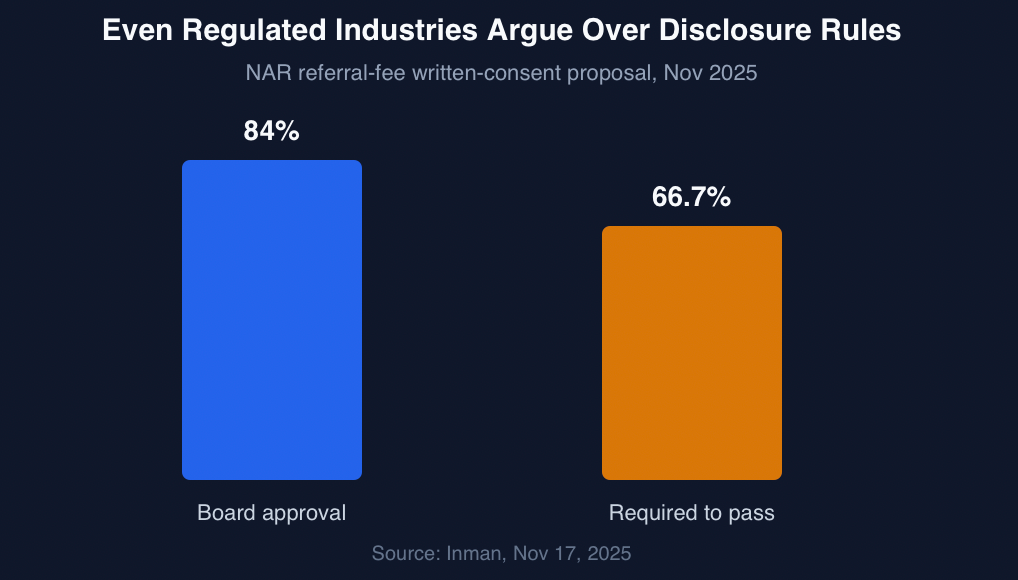
As of November 2025, NAR’s Board of Directors approved a written-consent proposal for referral-fee disclosures by an 84% margin. NAR’s own Delegate Body rejected it anyway, since it fell short of the required two-thirds threshold (Inman, 2025). Something else makes that vote matter. Even a large, established association hasn’t settled how much referral documentation should be mandatory. Tracked platforms remove that ambiguity by making documentation the default.
How Referral Platforms Prevent Two Agents From Claiming the Same Client
Do You Need a Written Agreement, or Is a Verbal Deal Enough?
Under general US contract-law principles, most oral agreements are enforceable if they meet standard requirements: an offer, an acceptance, and consideration. The Statute of Frauds and UCC Article 2 carve out categories that must be in writing, like goods over $500 in value. Most referral arrangements between two professionals don’t automatically fall into those categories.
Enforceable isn’t the same as easy to enforce. Even a verbal agreement that meets the legal bar still depends on both parties remembering the same terms. Precisely that failure mode is what a written or platform-logged agreement is designed to eliminate.

When we built MezAgent’s tracking system, the real risk we designed against wasn’t that a verbal deal might be unenforceable. It was that proving what was actually agreed to becomes a word-against-word argument with no independent record to settle it.
Do You Need a Written Agreement Before Referring a Client, or Is a Verbal Deal Enough?
Informal Referral vs. Tracked Platform: The Real Difference
Every mechanic covered above, attribution, verification, vetting, dispute resolution, adds up into a single system. An informal referral relies on memory, trust, and goodwill at every one of those steps. Its tracked counterpart replaces each of them with a record.
| Mechanic | Informal referral | Tracked platform |
|---|---|---|
| Attribution | Whoever remembers introducing the client first | Timestamped at the moment of introduction |
| Verification | Personal vouching, no formal check | Layered identity and business checks |
| Vetting | Based on a single conversation | Referral history visible before commitment |
| Dispute resolution | Word against word | Resolved against a logged record |
| Agreement | Often verbal, hard to prove later | Written or platform-logged by default |
None of this makes informal referrals bad. Most professional relationships still run on them, and plenty of referrals close cleanly without any of this infrastructure. What a tracked platform changes is what happens when something goes wrong. A missed payment, a disputed introduction, a client who says they never agreed to a fee: that’s where a record beats a memory.
Informal Referral vs. Tracked Platform: What Actually Changes
Frequently Asked Questions
How does a referral platform know who introduced a client first?
By logging the introduction as a timestamped event the moment it happens. First-touch attribution then credits whichever agent’s introduction was recorded earliest, not either agent’s account of what happened.
Does a verified identity guarantee a referral is legitimate?
No. Verification confirms someone is who they claim to be; it does not evaluate whether they are a good fit for a specific deal. In 2026, layered checks (contact verification, device signals, business registration) close identity risk, but vetting the actual fit is a separate step.
Is a verbal referral agreement legally binding?
Generally yes, if it meets standard contract requirements (offer, acceptance, consideration) and doesn’t fall under a Statute of Frauds category that requires writing. The practical problem isn’t enforceability, it’s proving the exact terms both sides agreed to.
What happens if a business’s records don’t match the platform’s tracking?
Well-built platforms treat this as a reconciliation problem, not an accusation. Timestamped introduction logs and the business’s own CRM data get compared directly, with the earlier, better-documented record typically taking precedence in a dispute.
The Bottom Line
Tracking, verification, and dispute resolution are not separate features bolted onto a referral platform. They are the answer to the same underlying question: what happens when a referral is worth real money and something goes wrong. If you’re an agent, this system is what turns a referral into a claim you can actually collect on. If you’re a business, it’s what lets you trust an introduction from someone you’ve never met.
How a Referral Platform Verifies That an Introduced Client Is Real
Sources
- Fingerprint, “Fingerprint Reports 65% ARR Growth, Surpasses 1 Billion Device Identifications Per Month as Enterprises Adopt Device Intelligence to Combat AI-Driven Fraud,” Feb 24, 2026, retrieved 2026-07-02. https://www.businesswire.com/news/home/20260224743088/en/Fingerprint-Reports-65-ARR-Growth-Surpasses-1-Billion-Device-Identifications-Per-Month-as-Enterprises-Adopt-Device-Intelligence-to-Combat-AI-Driven-Fraud
- Trulioo, “Global Survey: 79% of Companies Experience Business Identity Theft, Driving Urgency in Verification Market,” Oct 5, 2023, retrieved 2026-07-02. https://www.businesswire.com/news/home/20231005317544/en/Trulioo-Global-Survey-79-of-Companies-Experience-Business-Identity-Theft-Driving-Urgency-in-Verification-Market
- Inman, “Realtors Reject Proposal to Require Disclosure of More Referral Fees,” Nov 17, 2025, retrieved 2026-07-02. https://www.inman.com/2025/11/17/realtors-reject-proposal-to-require-disclosure-of-more-referral-fees/