They make more warm introductions in a week than most salespeople make in a month. Most of the time, no referral commission comes back.
Stan Sheyko, Co-Founder, MezAgent Former Vice President, Citi — 14 years managing HNW private banking relationships across EMEA
There is a specific kind of professional frustration that private bankers and wealth managers rarely talk about publicly — the missing private banker referral commission. It goes something like this.
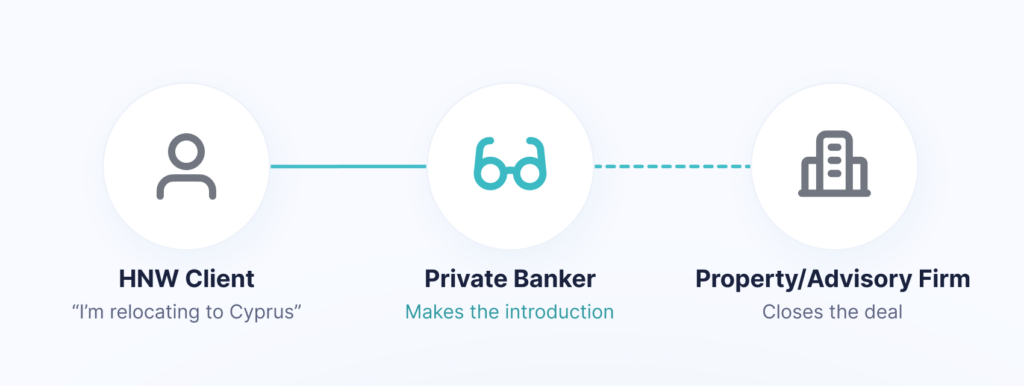
A client mentions they are thinking about moving to Cyprus. The banker knows exactly who to call — a property specialist, a residency advisor, a relocation firm. They make the introduction. Three months later the deal closes. They hear about it, if they are lucky, through the client. Nothing comes back. No acknowledgement. No compensation. Just a quiet assumption that the introduction was part of the service.
It is not. And the professionals who understand this earliest are already building a secondary income stream from their existing client relationships — without changing a single thing about how they work. This is the opportunity that the private banker referral economy is beginning to formalise.
“Private bankers and wealth managers are the most trusted professionals in the HNW world. They are also the most systematically undercompensated for the introductions they make every day.”
The structural advantage private bankers already have
A private banker’s relationship with a high net worth client is not a transactional one. It is built over years, sometimes decades. The client does not just share their financial situation — they share their plans, their concerns, their family decisions, their ambitions. When that client decides to relocate to Dubai, acquire property in Portugal, or explore a Golden Visa programme in Greece, the private banker is often the first person they tell.
That conversation is not the banker’s core service. But it is genuinely valuable to the businesses whose services the client needs — and it is the definition of a warm introduction. Trust already exists. The introduction carries relationship capital that cold outreach cannot manufacture.
Wealth manager referral arrangements formalise exactly this dynamic. The banker introduces the client. The business serves them. The banker earns a percentage of the deal value — agreed upfront, before any client details are shared.
Why most private bankers have never formalised this
Compliance and regulatory concern
In regulated financial environments, advisors are rightly cautious about referral arrangements. In many jurisdictions, referring clients to third-party providers requires disclosure — and in some cases, formal approval. This concern is legitimate and worth addressing with a compliance officer before entering any referral arrangement. However, the requirement is usually straightforward — transparency with clients, not prohibition.
No infrastructure to manage it
Without a referral tracking system, managing multiple informal referral relationships across different industries and countries is genuinely difficult. Who referred whom? When did the introduction happen? Has the deal closed? Without secured and trackable infrastructure, the answer to all three questions is often uncertain.
Cultural assumption that it is part of the service
In private banking, the culture of going above and beyond for clients — including making introductions — is deeply embedded. The idea of being compensated for those introductions can feel uncomfortable. It should not. The introduction has real commercial value. The business that receives a qualified HNW client through a trusted professional knows exactly what that introduction is worth.
What the numbers look like
A private banker introduces a high net worth client to a Cyprus property developer. The client purchases a €800,000 property. The developer has agreed a referral commission of 5% — €40,000 — payable when the transaction completes. The banker made one phone call.
The same banker introduces a client to a Golden Visa advisory firm in Greece. The firm’s service fee for the engagement is €8,000. The referral commission, agreed at 20% of that fee before the introduction was made, is €1,600 — paid when the client completes their engagement.
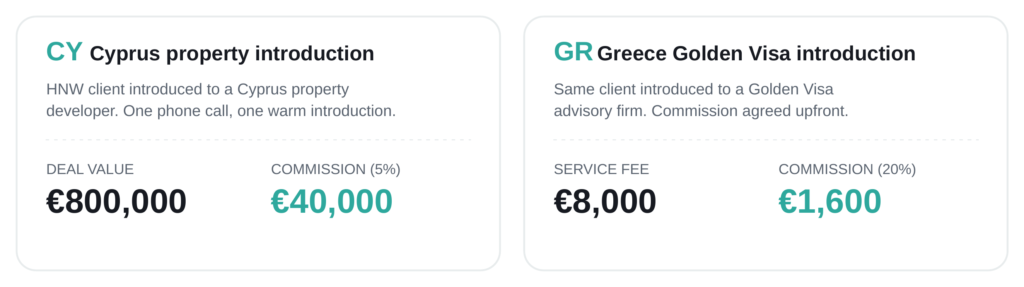
These are not exceptional scenarios. They are the ordinary commercial reality of the HNW advisory world — for professionals who have formalised what they were already doing informally.
“The introduction has always had value. The only question is whether the structure exists to capture it.”
How a structured referral network changes the economics
A HNW referral platform like MezAgent provides three things that informal arrangements cannot: a secured digital referral agreement generated at the moment of introduction, a trackable record of every deal from introduction to close, and a payment structure that is scalable across multiple relationships simultaneously.

The banker does not need to chase the business for payment six months after a deal closes. The agreement exists from the moment the introduction was made. The deal is tracked. The commission is protected.
The advisor network on MezAgent spans 15+ countries and includes private bankers, wealth managers, IFAs, relocation specialists, immigration lawyers, and family office professionals. Every business on the platform was manually reviewed before joining — so advisors know they are introducing clients to verified, serious firms. MezAgent takes zero commission on any deal. The referral commission belongs entirely to the introducing professional. Read more on the MezAgent blog about how other advisors are structuring their referral income.
| ✓ Secured agreement Generated digitally the moment an introduction is made — enforceable from that point forward. | ⇄ Tracked, end to end Every introduction has a record — from first contact through to close. No more guesswork. | € 0% platform commission What you earn on a deal is what you keep. MezAgent does not take a cut. |
Where these introductions actually come from
Most private bankers assume referral income means one or two opportunities a year. In practice, a single HNW client relationship typically touches four distinct categories of introduction over its lifetime — each with its own referral economics.
Real estate and property investment
Second homes, buy-to-let portfolios, and relocation-driven purchases are the most frequent introduction a private banker makes. Commission is typically a percentage of the property’s sale price, agreed with the developer or agency before the client is introduced.
Investment migration and residency planning
Golden Visa and citizenship-by-investment programmes generate a steady flow of introductions for clients diversifying residency or relocating for tax purposes. Commission is usually a percentage of the advisory firm’s service fee, paid once the client’s application is filed or completed.
Independent wealth management and IFA referrals
When a client’s needs fall outside a bank’s mandate — a smaller portfolio, a specific asset class, or a jurisdiction the bank does not cover — an introduction to an independent financial advisor keeps the relationship intact and creates a referral fee for the banker.
Legal, tax, and family office advisory
Succession planning, cross-border tax structuring, and family office set-up are introductions a private banker makes constantly but rarely formalises. These engagements tend to be high-value and long-running, which makes the referral commission meaningful even at a modest percentage.
None of these categories require the banker to change how they work. The introduction already happens in the normal course of the client relationship. What changes, on a structured platform, is whether that introduction is recorded, tracked, and paid for.
FAQ Frequently asked questions
Can private bankers legally earn referral commissions?
In most jurisdictions, yes — subject to disclosure requirements and compliance approval. The specific rules vary by country and regulatory framework. The requirement is usually transparency with clients rather than prohibition. Always confirm with your compliance officer before entering any referral arrangement. Most private bankers who have done this find the disclosure requirement is a short form, not a barrier.
Does making a referral create any ongoing responsibility?
No. The introducing professional connects two parties and earns a percentage of the resulting deal. They do not become responsible for the service delivered by the business. The referral arrangement is a commercial agreement between the advisor and the business — separate from the client’s relationship with either party.
How is the commission agreed?
The commission percentage is agreed directly between the advisor and the business before any client details are shared. On a structured HNW referral platform, this agreement is recorded digitally at the moment of introduction — making it enforceable and trackable from that point forward.
Stop giving away the introduction
You already make the calls. You already carry the trust. Start protecting what those introductions are worth — join MezAgent free and track every referral from introduction to commission paid.