A number gets repeated so often in referral marketing content that it’s treated as settled fact: referred customers convert roughly 30% better than customers from other channels. Search for the original source and you’ll find referral-software marketing blogs, not a study. This piece separates the one hard, verifiable cost figure in this comparison, Google Ads pricing, from the genuinely unverified claims about referral conversion, and looks at what peer-reviewed research actually says.
Referral platforms vs. every other way to get clients
Cross-border professionals deserve better than a recycled percentage with no traceable origin. This piece walks through the real cost side (paid search), the real research side (peer-reviewed academic work on referral value), and the honest gap between the two, so you can make a budget decision based on what’s actually known rather than what’s convenient to believe.
Key Takeaways
- Google Ads for legal and financial-services keywords commonly cost $6-$9 or more per click (WordStream, 2023), a verifiable, sourced figure.
- The widely repeated “referred customers convert 30% better” claim traces back to referral-software marketing blogs, not independent research, and should not be cited as fact.
- Peer-reviewed research published in the Journal of Marketing found referred customers can carry different long-term value than customers acquired through other channels, but that research studied retail banking, not professional services.
- No published, sector-specific study measures referral conversion rates for cross-border property, immigration, tax, or wealth-management referrals; this piece says so directly rather than filling the gap with an invented number.
The most useful thing this piece can do isn’t hand you a cleaner statistic to replace the vendor one. It’s show you why no clean, sector-specific statistic currently exists, and what to track yourself instead. Treating an absence of data as a data point is, honestly, more useful than borrowing a number that was never measured for your industry in the first place.
Where the “30% Better” Referral Claim Actually Comes From
The claim that referred customers convert roughly 30% better than other acquisition channels shows up across dozens of marketing blogs, nearly all published by companies that sell referral or loyalty software. None of those articles link to a disclosed methodology, sample size, or peer-reviewed publication behind the number.
That pattern alone is worth pausing on. A company selling referral software has a direct commercial interest in a statistic that makes referral programs look superior to every other acquisition channel. That doesn’t automatically make the number false, but it does mean it fails a basic test: no independent party has verified it, and the parties repeating it all benefit from you believing it.
In conversations with agents building cross-border referral practices, a recurring pattern is that this exact percentage gets quoted back at us as though it were established research. When asked for the underlying source, nobody has ever pointed to anything more specific than “a blog I read.” That’s not a knock on those agents. It’s how a repeated number quietly becomes accepted wisdom without anyone checking the original claim.

Citation capsule: The commonly repeated claim that referred customers convert roughly 30% better than customers from other channels traces back to referral-software marketing blogs rather than independent, peer-reviewed research, and no disclosed methodology or sample size supports the figure.
Why This Matters More for Professional Services Than Retail
A wrong assumption costs more when deal values are high and sales cycles are long, which describes most cross-border professional-services work. A retail brand acting on an unverified 30% figure risks a marketing budget line. A property agent or immigration consultant acting on the same unverified number risks months of relationship-building time and real client revenue.
The stakes are different because the unit economics are different. A single missed or mismanaged cross-border referral can represent a client relationship worth far more than an average retail transaction, so building a strategy on an unsourced percentage carries more downside here than it would for a low-cost consumer product.
Informal referral or tracked platform, which actually pays off
What Does Peer-Reviewed Research Actually Say About Referred Customers?
The most credible academic research on this topic comes from a study published in the Journal of Marketing by researchers Bernd Schmitt, Bernd Skiera, and Christophe Van den Bulte, examining referred customers at a European retail bank. The study found referred customers showed measurably different value and retention patterns compared to customers acquired through other channels (Schmitt, Skiera & Van den Bulte, Journal of Marketing, 2011).
That’s a real, peer-reviewed, independently conducted study, a meaningfully different category of evidence than a vendor blog post. It examined actual bank customer records over time rather than relying on self-reported survey data or an undisclosed internal dataset, which is exactly the kind of rigor a marketing-vendor claim typically lacks.
Here’s the honest caveat that gets dropped every time this study is cited secondhand: it examined retail banking customers acquired at a European bank, not cross-border property, immigration, tax, or wealth-management clients. The finding is real. Its applicability to professional-services referrals is an analogy, not a proven extension. Anyone citing this study as direct proof for a different industry is overstating what the research actually measured.
Retail banking and cross-border professional services differ in ways that matter for this specific question. Bank customers open accounts in minutes; a cross-border property or immigration case can take many months to close. Banking referrals often involve small individual account values; a single referred client in wealth management or property can represent a transaction worth far more than a typical banking relationship. Extending banking-sector findings to professional services requires treating the research as directional evidence, not sector-specific proof.
Citation capsule: Peer-reviewed research by Schmitt, Skiera, and Van den Bulte, published in the Journal of Marketing in 2011, found that referred bank customers showed different long-term value patterns than customers acquired through other channels, though the study examined retail banking specifically, not professional services referrals.
Does This Research Apply Directly to Cross-Border Professional Services?
Not directly, and any claim that it does should be treated skeptically. The study’s data came from a single European retail bank’s customer base, a context with shorter sales cycles, lower average transaction values, and different regulatory dynamics than cross-border property, immigration, tax, or wealth-management work.
What the research does offer is a reasonable, honestly-caveated starting hypothesis: referred customers may behave differently than customers from other channels in ways that persist over time. Whether that pattern holds, and at what magnitude, for a specific professional-services niche remains an open, unanswered question until someone runs that specific study.
Referral partners vs. paid ads, where to put your acquisition budget
Paid Advertising Costs Are the One Number Here You Can Actually Verify
Unlike the referral-conversion claim, paid advertising cost is genuinely well-documented. Google Ads for legal and financial-services keywords commonly runs $6 to $9 or more per click, according to WordStream’s 2023 Google Ads benchmark report, one of the more consistently cited industry benchmark sources for this figure.
That’s the price of a single click landing on a page, not a qualified lead and certainly not a signed client. A cross-border immigration lawyer or tax advisor bidding on competitive terms in a major market can spend that per-click cost hundreds of times over before a single inquiry converts into a paying engagement.

This is the asymmetry worth sitting with. On the cost side, we have a named source, a specific figure, and a retrieval date. On the referral-conversion side, the most commonly cited number has none of those things. Comparing a verified cost against an unverified conversion claim isn’t really a comparison, it’s a category error dressed up as one.
Citation capsule: Google Ads for legal and financial-services keywords commonly cost $6 to $9 or more per click, according to WordStream’s 2023 Google Ads benchmark report, a figure with a named source and retrieval date, unlike the unsourced referral-conversion percentages that typically get compared against it.
Why Is the Cost Side So Much Easier to Verify Than the Conversion Side?
Ad platforms report cost-per-click directly and transparently, because the platform itself processes the transaction and has no reason to obscure the number. Referral conversion, by contrast, depends on each individual practice tracking its own outcomes, data that mostly doesn’t exist in any centralized, auditable form.
That structural difference explains why cost figures for advertising are easy to source while referral-conversion figures are easy to fabricate. Nobody independently audits a vendor’s claim about referral performance the way an ad platform’s billing system audits a cost-per-click figure.
Referral platform vs. paid networking group, a real cost comparison
How Should You Actually Compare These Two Channels?
The honest comparison pits a verified cost figure against an unverified conversion claim, which means the fair conclusion is “track your own numbers,” not “referrals definitively convert better.” Google Ads cost-per-click is real and sourced; the referral-conversion advantage most commonly cited is not, and pretending otherwise misleads the exact decision this comparison is supposed to inform.
That doesn’t mean referrals are a weak channel, or that the retail-banking research is irrelevant. It means the sector-specific claim professionals actually want, “how much better do my referred cross-border clients convert compared to my paid-ad leads,” has no published answer yet. The only way to get that answer for your own practice is to measure it yourself.
Among the cross-border professionals we’ve spoken with, several who tracked both channels side by side for at least a year described referred clients closing at a noticeably higher rate than paid-ad leads, though the specific margin varied widely from practice to practice and none had a large enough sample to call it a reliable percentage. This is a directional pattern from our own conversations, not a controlled study, so treat it as anecdotal rather than a benchmark you can apply to your own numbers.
The chart below lays out what’s actually known versus assumed across the two channels. Notice that the cost column has a hard number with a source, while the conversion column deliberately doesn’t, because no honest, sector-specific number currently exists.
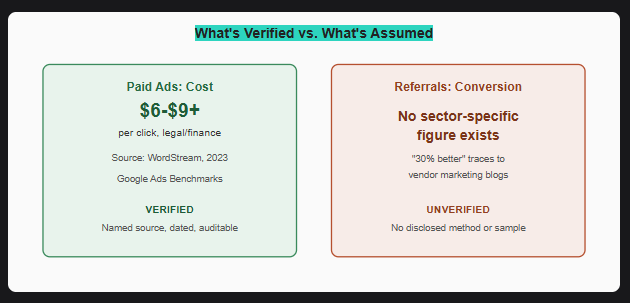
Chart: One side of this comparison has a named, sourced figure. The other, as commonly cited, does not. Source: WordStream Google Ads Benchmarks, 2023; qualitative assessment of referral-marketing claims based on publicly available vendor content.
Citation capsule: A fair comparison between paid ads and referrals should weigh a verified cost figure, $6 to $9 or more per click for legal and financial keywords according to WordStream’s 2023 report, against the honest absence of a sector-specific, peer-reviewed referral-conversion figure for cross-border professional services.
What Should You Measure Instead of Trusting a Borrowed Number?
Track three things for your own practice: how many referrals arrived this quarter, how many converted to signed clients, and what the same time period’s ad spend produced for the same effort. That comparison, run on your own data, tells you something a vendor’s blog post never could.
Without that tracking, you’re choosing between two unverified stories: a vendor’s promotional percentage, or an assumption that ads are simply easier to measure because the cost side happens to be. Neither assumption should decide a budget on its own, and only your own numbers settle the question honestly.
The Real Reason Sector-Specific Referral Research Doesn’t Exist Yet
Academic marketing research requires access to detailed, longitudinal customer data, and cross-border professional-services firms, property agencies, immigration practices, tax advisors, and wealth managers, rarely maintain the kind of centralized, research-ready dataset that a bank or large retailer can hand to a university research team. That access gap is a likely reason no equivalent study has been published for this sector.
Retail banks like the one studied by Schmitt, Skiera, and Van den Bulte process thousands of customers through standardized systems, making large-sample, longitudinal analysis feasible. A solo immigration consultant or a small cross-border property brokerage handles a much smaller volume of clients, often without a shared tracking system at all, which makes the kind of dataset academic researchers need difficult to assemble in the first place.
What we’ve noticed in speaking with agents across property, immigration, and tax practices is that almost none of them had, before adopting any kind of tracking system, a clean record of which clients came from which referral source and how those clients compared to ad-acquired clients on conversion or retention. That absence of internal data isn’t a criticism of any individual practice. It’s simply a structural gap that also explains why nobody has published sector-specific research yet: the underlying data mostly doesn’t exist in a usable form.
That gap is closing as more practices adopt referral-tracking systems, since tracked data is exactly the kind of dataset that could eventually support sector-specific research. Until that research is published, though, professionals are better served by tracking their own conversion numbers than by borrowing a retail-banking finding or a vendor’s promotional claim as if either settled the question.
Could a Practice’s Own Tracked Data Eventually Fill This Gap?
Yes, in principle. A referral-tracking system that records introduction date, referral source, deal status, and outcome creates exactly the kind of structured dataset that academic researchers currently lack for this sector. Enough practices tracking consistently over several years could, in theory, support the first sector-specific study.
That’s a multi-year proposition, not a near-term fix. In the meantime, the honest position is that any professional-services-specific referral-conversion percentage you encounter anywhere, from any source, should be scrutinized for its methodology and sample size just as rigorously as the vendor claims this piece has spent most of its length questioning.
Frequently Asked Questions
Is it true that referred customers convert 30% better than paid-ad customers?
That specific figure isn’t independently verified. It traces back to referral-software marketing blogs rather than peer-reviewed research, and no disclosed methodology or sample size supports it, so it shouldn’t be cited as an established fact for any industry.
What does real academic research say about referral value?
A 2011 Journal of Marketing study by Schmitt, Skiera, and Van den Bulte found referred bank customers showed different long-term value patterns than other customers. The study examined retail banking specifically, not cross-border professional services, so its findings apply by analogy only.
How much does paid advertising actually cost for legal or financial services?
Google Ads commonly runs $6 to $9 or more per click in legal and financial-services categories, according to WordStream’s 2023 Google Ads benchmark report, a cost charged regardless of whether the click ever converts.
Does any published research measure referral conversion for property or immigration referrals specifically?
No. No published, peer-reviewed study currently measures referral conversion rates for cross-border property, immigration, tax, or wealth-management referrals specifically, and this piece states that gap directly rather than filling it with an unverified figure.
What should I track instead of relying on an industry-wide referral statistic?
Track your own referral volume, your own conversion rate to signed clients, and how that compares to what the same period’s ad spend produced. Your own numbers, measured over time, are more useful than any borrowed percentage from another industry.
Conclusion: Trust the Sourced Number, Question the Unsourced One
This comparison started with an uneven playing field, and it ends with one too, just an honestly labeled one. Google Ads cost-per-click for legal and financial keywords is real, sourced, and verifiable at $6 to $9 or more (WordStream, 2023). The “referred clients convert 30% better” claim is not, and treating it as fact does a disservice to every professional making a real budget decision.
Peer-reviewed research does exist on referral value, from Schmitt, Skiera, and Van den Bulte’s 2011 Journal of Marketing study, but it studied retail banking, not cross-border professional services. Extending that finding to your own practice is a reasonable hypothesis, not a proven fact, and this piece has tried to say so at every point rather than blur the two.
The practical takeaway is simple, even if it isn’t as satisfying as a clean percentage: build your own tracking, measure your own referral and ad conversion side by side, and let that data, not a recycled vendor statistic, guide where your next dollar goes.
About the Author: Stan Sheyko is Co-Founder of MezAgent, a referral-tracking platform built for cross-border professionals in property, immigration, legal, tax, and wealth management.
This article is for general informational purposes only and does not constitute legal, tax, financial, or investment advice. Referral fee rules, fee-splitting restrictions, and disclosure requirements vary by profession, state, and country, and can change over time. Consult a licensed professional in the relevant field before entering into or relying on any referral fee arrangement described here.
Sources
- WordStream, “Google Ads Benchmarks for 2023,” retrieved 2026-07-14, https://www.wordstream.com/blog/ws/2023/03/07/google-ads-benchmarks
- Schmitt, P., Skiera, B., & Van den Bulte, C., “Referral Programs and Customer Value,” Journal of Marketing, Vol. 75, No. 1, 2011, retrieved 2026-07-14, https://journals.sagepub.com/doi/10.1509/jm.75.1.46