Insights8 min read
Can UK and Cyprus Law Firms Pay Referral Fees to Non-Lawyer Introducers?
England and Wales allows referral fees with transparency; Cyprus restricts them sharply. How the two rulebooks compare, and what clients must be told.

Published 23 November 2026
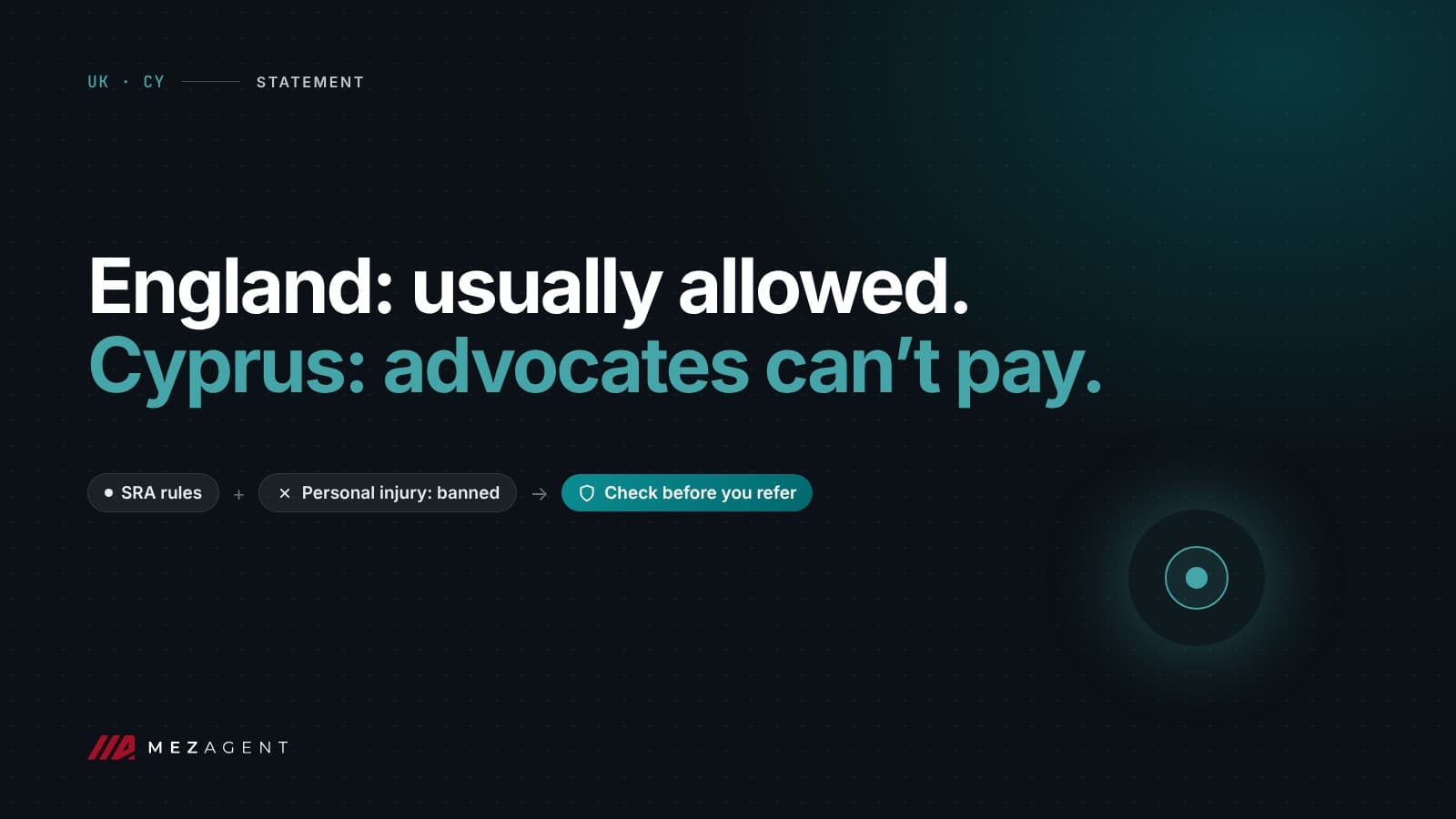
In England and Wales, solicitors can generally pay referral fees to non-lawyers if they follow the SRA's rules on transparency and client interests, but referral fees are banned in personal injury cases. In Cyprus, the Cyprus Bar Association's Code of Conduct is much stricter: its published rules say advocates may not pay a fee or commission to anyone for recommending a client. Firms should always check their regulator's current guidance before agreeing terms.
Law firms receive a large share of their best clients through introductions: from private bankers, accountants, property firms and relocation specialists. Whether a firm can pay those introducers depends on where the firm is regulated and what kind of work the client needs.
This guide compares the general position in England and Wales and in Cyprus, two markets where cross-border legal work often meets cross-border introductions.
Key Takeaways
- In England and Wales, solicitors can generally pay referral fees to non-lawyers if they follow the SRA's transparency rules, but fees are banned in personal injury cases under section 56 of LASPO 2012.
- The Cyprus Bar Association's published Code of Conduct is much stricter: advocates may not pay a fee or commission to anyone for recommending a client.
- Where fees are allowed, disclosure is central: the client must be told about the introducer's interest and any relevant fee sharing, and the arrangement must be in writing.
- The test in every jurisdiction is whether the arrangement keeps the lawyer independent and the client's interests first.
Why Does the Answer Differ by Country?
Every country regulates its lawyers differently. Some treat referral fees as a normal commercial arrangement, provided the client is protected. Others see any payment for a client as a risk to a lawyer's independence and ban it outright.
So the question is never just can lawyers pay referral fees? It is can this lawyer, regulated by this body, pay this fee, for this type of work? The table below shows how differently two common markets answer it.
England and Wales vs Cyprus: How the Rules Compare
The table sets out the two regulators' positions side by side on the questions a firm needs answered before agreeing terms with a non-lawyer introducer.
| Question | England and Wales (solicitors) | Cyprus (advocates) |
|---|---|---|
| Regulator | Solicitors Regulation Authority (SRA) | Cyprus Bar Association |
| Can a firm pay a non-lawyer introducer? | Generally yes, with transparency rules | The published Code says advocates may not pay for recommending a client |
| Areas where referral fees are banned | Personal injury and death claims | Not limited to one area under the Code |
| Client disclosure | Required for introducer interests and fee sharing | Not applicable where payment is not permitted |
| Written agreement | Fee sharing arrangements must be in writing | Not applicable where payment is not permitted |
What Do the SRA Rules Say in England and Wales?
The SRA does not ban referral fees in general. Instead, its Code of Conduct for Solicitors sets conditions that protect clients. In broad terms, where a third party introduces business or shares fees, the firm must make sure that:
clients are told about any financial or other interest the introducer has in referring them
clients are told about any fee sharing arrangement relevant to their matter
the fee sharing agreement is in writing
no referral payments are made or received for clients who are the subject of criminal proceedings
the client was not obtained in a way that would break SRA rules if the introducer were regulated
The underlying principles still apply too. A referral arrangement must not compromise the solicitor's independence or the client's best interests. The SRA's guidance on referral fees, LASPO and the SRA Principles explains how these fit together.
Where Are Referral Fees Banned in England and Wales?
Section 56 of the Legal Aid, Sentencing and Punishment of Offenders Act 2012 bans paying or receiving referral fees for prescribed legal services. In practice, that means claims for damages for personal injury or death. The ban covers solicitors as well as others such as claims management businesses and insurers.
The SRA's guidance on the prohibition of referral fees in LASPO sets out what is covered. For most of the work that cross-border introductions involve, such as property, immigration, corporate, tax and private client matters, the LASPO ban does not apply, but the Code of Conduct conditions above still do.
What Does the Cyprus Bar Association's Code Say?
Cyprus takes a much stricter line. The Code of Conduct Regulations published by the Cyprus Bar Association include several rules that bear directly on referral fees:
advocates must not use agents or brokers to steer cases to their firm, or reward anyone for influencing people to seek their services
advocates may not pay part of their fees to people who are not advocates
advocates may not pay a fee, commission or other compensation to a person for recommending a client, and may not accept one for sending a client to another advocate
Read together, these rules mean a Cyprus advocate generally cannot pay a non-lawyer introducer a referral fee. Breaches are a disciplinary matter. If you work with Cyprus law firms, either as a firm or as an introducer, check the Bar Association's current rules and ask the firm how it handles introductions before any client is referred.
Do Clients Need to Be Told About a Referral Arrangement?
Where referral fees are allowed, disclosure is usually central to the rules. In England and Wales, the client must be told about the introducer's interest and any relevant fee sharing. Good disclosure is short and plain. For example:
Example only: You were introduced to us by [introducer]. We have an agreement with them and pay them a fee for introductions. This does not change our fees to you or our duty to act in your best interests.
Even where disclosure is not strictly required, telling the client builds trust and prevents awkward questions later.
What Are the Alternatives to Paying a Referral Fee?
Where referral fees are restricted or banned, firms still build referral relationships. Common approaches include:
Reciprocal referrals without payment. Firms and professionals refer clients to each other because it serves the client, with no fee changing hands.
Marketing arrangements not linked to specific clients. In some jurisdictions, paying for genuine marketing or advertising services is treated differently from paying for a client. In Cyprus, the Code's wording on rewarding others is broad, so take guidance first.
Formal partnerships and alliances. Some firms join cross-border networks that share work without paying per client.
Whatever the structure, the test is the same: does it keep the lawyer independent and the client's interests first?
How Does MezAgent Fit With Law Firm Rules?
MezAgent does not decide what a law firm may pay. Each firm sets its own offer on the platform and remains responsible for complying with its regulator's rules.
Where a firm's rules allow referral fees, MezAgent helps it meet the conditions that regulators usually set:
the fee and terms are agreed in a digital referral agreement before any client details are shared, which gives the firm a written record
the deal is tracked by both sides, so there is no dispute about who introduced whom
MezAgent takes 0% platform commission, so there is no hidden third-party share of the fee
If your regulator does not allow you to pay introducers, do not post a fee-based offer. You can book a call to discuss your situation. Introducers working with law firms may also find our guide on what immigration lawyers should know about referral partnerships useful, and our checklist for checking a Cyprus law firm before referring a client.
Frequently Asked Questions
Can a solicitor pay a referral fee?
In England and Wales, generally yes, if the solicitor follows the SRA Code of Conduct. That means telling the client about the introducer's interest and any fee sharing, putting the arrangement in writing, and keeping the client's interests first. Referral fees are banned in personal injury cases.
Are referral fees banned in personal injury cases?
Yes. Section 56 of the Legal Aid, Sentencing and Punishment of Offenders Act 2012 bans paying or receiving referral fees for personal injury and death claims in England and Wales. The ban applies to solicitors and to others such as claims management firms and insurers.
Can a Cyprus lawyer pay an introducer?
The Cyprus Bar Association's published Code of Conduct says advocates may not pay a fee or commission to anyone for recommending a client, or share their fees with non-advocates. Check the Bar Association's current rules before agreeing any arrangement.
The Bottom Line
England and Wales and Cyprus sit at opposite ends of the same question. The SRA allows referral fees in most areas of work, provided the client is told, the arrangement is in writing and independence is protected. The Cyprus Bar Association's published Code says advocates may not pay for a client at all.
Before agreeing terms with an introducer, check the regulator's current guidance, confirm the type of work is not in a banned area, and make sure the client is told what the arrangement is. If the rules do not allow a fee, build the relationship on reciprocal referrals instead.
Sources
This article is for general informational purposes only and is not legal, tax, or immigration advice. Rules vary by jurisdiction and change frequently. Consult a licensed professional before making decisions based on this content.
Free forever for professionals. No card required.
Sign up