Insights7 min read
What Immigration Lawyers Should Know About Referral Partnerships
Immigration lawyers are natural hubs for referrals. What their regulators require, how to choose partners, and how to track referrals in both directions.

Published 24 November 2026
Immigration lawyers can build strong referral partnerships with private bankers, tax advisers, property firms and relocation specialists, as long as they follow their regulator's rules on referral fees, client interests and disclosure. The partnerships that work best are written down, transparent to the client and tracked in both directions.
An immigration case rarely stands alone. A family moving to Portugal or Malta also needs somewhere to live, a bank account, tax advice and often schools and insurance. The immigration lawyer is often the first professional they trust, and the one they ask for every other recommendation.
That makes immigration lawyers natural hubs for referrals. It also means the professional rules around referrals matter more for them than for most introducers.
Key Takeaways
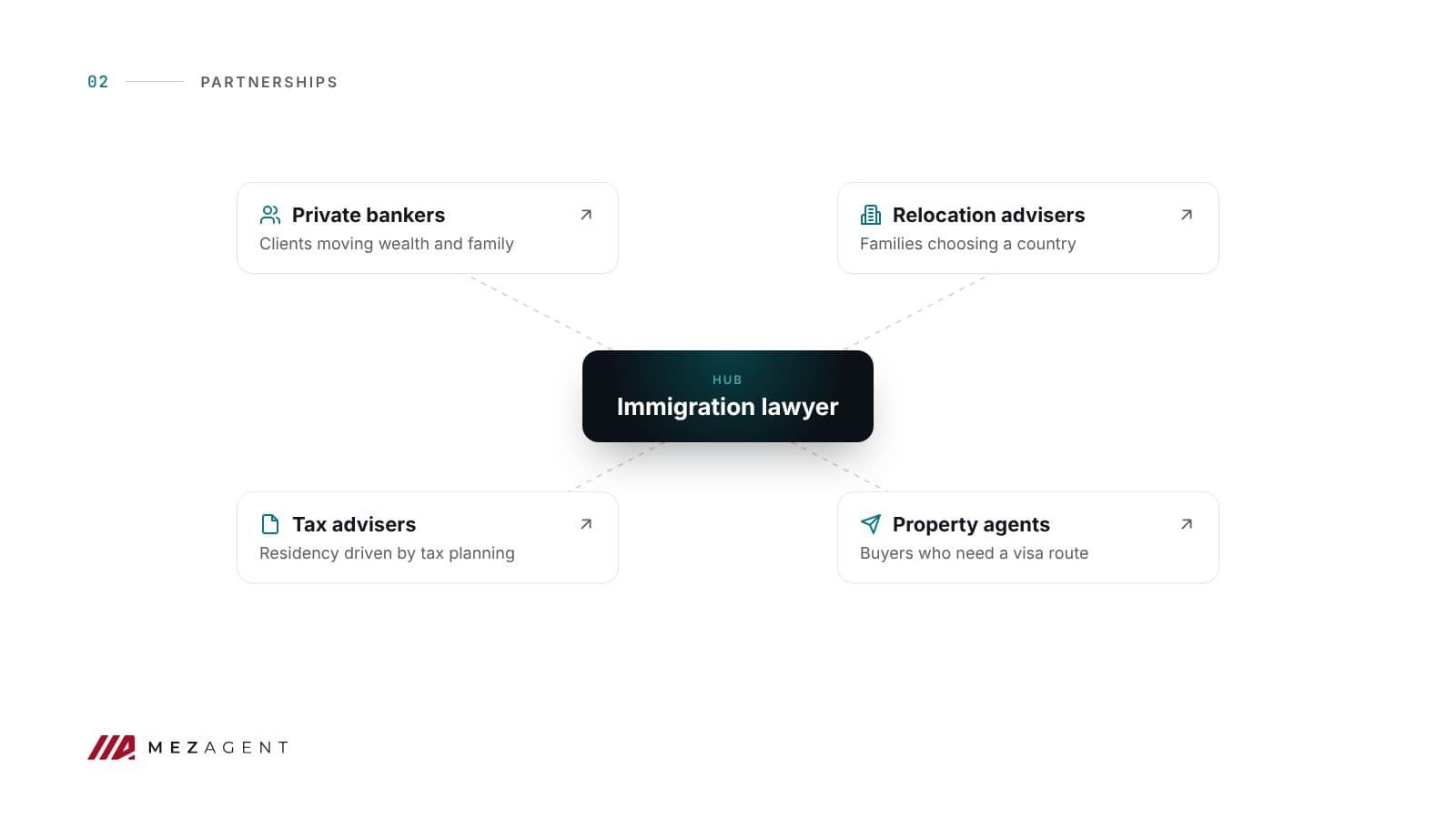
- Immigration clients usually arrive through someone they already trust: private bankers, tax advisers, property firms, relocation specialists and other law firms.
- Most immigration lawyers both receive and give referrals, and regulators may treat the two directions differently, so check both.
- Where referral fees are allowed, disclosure is usually required and always good practice, because a client who learns about a fee later loses trust quickly.
- A spreadsheet works for a handful of partners; beyond that, a shared tracking system keeps both sides informed and stops fees going unpaid.
Who Refers Clients to Immigration Lawyers?
Immigration clients usually arrive through someone they already trust. The most common sources are:
| Referral partner | Why they refer immigration clients |
|---|---|
| Private bankers and wealth managers | Clients ask about residency or citizenship options as part of wealth and succession planning |
| Tax advisers and accountants | A move changes a client's tax residence, so immigration and tax questions arrive together |
| Property developers and agents | Some residency programmes are linked to property, and buyers need legal help |
| Relocation and family office specialists | They manage the whole move and bring in lawyers for the immigration side |
| Other law firms | Corporate or private client firms refer immigration work they do not handle |
Should You Give Referrals, Receive Them, or Both?
The best partnerships run both ways. A lawyer who receives clients from a tax adviser is usually well placed to send clients back. Most immigration lawyers do both: you receive clients from bankers, advisers and agents, and you send your clients to property firms, banks and tax specialists for the parts of the move you do not handle.
The two directions raise different questions:
Receiving referrals. Can you pay the introducer? Must you tell the client? Does the introducer's role affect your independence?
Giving referrals. Can you accept a fee for recommending a property firm or a bank? Must the client know? Is the business you recommend reliable?
Your regulator's rules may treat these two directions differently, so check both.
What Professional Rules Apply to Referral Arrangements?
The rules depend on where you are qualified and who regulates you. A few examples, in general terms:
Solicitors in England and Wales follow the SRA Code of Conduct for Solicitors. Referral arrangements are generally allowed, but clients must be told about the introducer's interest and any fee sharing, the arrangement must be in writing and it must not compromise your independence or the client's interests.
Non-solicitor immigration advisers in the UK are regulated by the Immigration Advice Authority, formerly the OISC, which sets its own standards for advisers.
Advocates in Cyprus follow the Cyprus Bar Association's Code of Conduct, which restricts paying and accepting fees for recommending clients.
Lawyers in other countries follow their national bar association, and the rules range from permissive to strict.
For a closer comparison of two common markets, read can UK and Cyprus law firms pay referral fees to non-lawyers.
Do Clients Need to Know About a Referral Arrangement?
In many jurisdictions, yes, and even where it is not required, it is good practice. Immigration clients are often making life-changing decisions under time pressure. Finding out later that a recommendation came with a fee can damage trust quickly.
A short, plain statement is usually enough. For example:
Example only: We work with [partner] on the property side of residency applications. They pay us a fee when a client we introduce goes ahead. You are free to choose any provider, and our advice to you does not depend on your choice.
Agree the wording with your partner, and check that it meets your regulator's requirements.
How Should Immigration Lawyers Choose Referral Partners?
Your name is attached to every recommendation you make, so choose partners as carefully as you would choose a co-counsel. Before you send a client, check the partner's licence, ask who will handle the client, agree when any fee is due and how you will be kept updated.
Our checklist of 10 questions to ask a referral partner in your first meeting covers this in detail. Pay attention to how the partner treats your client's data. Immigration files hold passports, financial records and family details.
How Do You Track Referrals in Both Directions?
Without tracking, referral partnerships drift. You forget who sent whom, a fee goes unpaid, or a partner feels the relationship is one-sided. Simple tracking prevents most of this:
record every introduction, with the date, the client reference and the partner
note the agreed terms, including any fee and when it becomes due
update the status as the case moves forward
review each partnership every few months: who referred, who converted, who paid
A spreadsheet works for a handful of partners. Beyond that, a shared system is easier to keep accurate.
How Can MezAgent Help Immigration Lawyers?
On MezAgent, immigration lawyers can act as introducers, recommending businesses that have been checked for reputation, such as property developers, banks and tax firms to their clients, and track each introduction from start to finish.
Terms are agreed in a digital referral agreement before any client details are shared.
Both sides see the deal's progress, so you do not need to chase updates.
MezAgent takes 0% platform commission on any fee.
It is free to join as a professional.
Whether you may accept a fee for a particular introduction is a question for your own regulator's rules. See how the platform works for lawyers on our pages for investment migration professionals and legal and tax advisers. For definitions, see referral fee vs commission.
Frequently Asked Questions
Can immigration lawyers receive referral fees?
It depends on who regulates them. Solicitors in England and Wales can generally receive referral payments if the client is told and the arrangement does not compromise their independence. Some countries, such as Cyprus, restrict lawyers from accepting fees for recommending clients. Check your regulator's current rules.
Who are the best referral partners for immigration lawyers?
Private bankers, wealth managers, tax advisers, property developers and relocation specialists are common partners, because their clients often need immigration help at the same time. The best partners refer in both directions and serve the same type of client.
How do I track referrals?
Record each introduction with the date, client reference, partner and agreed terms, then update the status as the case progresses. A spreadsheet works for a few partners. A shared platform makes it easier to keep both sides informed.
The Bottom Line
Immigration lawyers sit at the centre of a client's move, which makes them both a natural receiver of introductions and a natural source of them. The rules on paying and accepting fees differ by regulator and by direction, so check both before agreeing anything.
Where fees are allowed, write the terms down, tell the client and track the referral so nobody has to chase an update. Where they are not, reciprocal referrals still build the relationship.
Sources
This article is for general informational purposes only and is not legal, tax, or immigration advice. Rules vary by jurisdiction and change frequently. Consult a licensed professional before making decisions based on this content.
Free forever for professionals. No card required.
Sign up