Insights8 min read
Italy Golden Visa Cost Breakdown: Investment, Fees and Other Costs
Italy's investor visa starts at EUR 250,000 and runs to EUR 2 million, before visa, permit, legal and translation costs. A full breakdown by route.

Published 25 November 2026
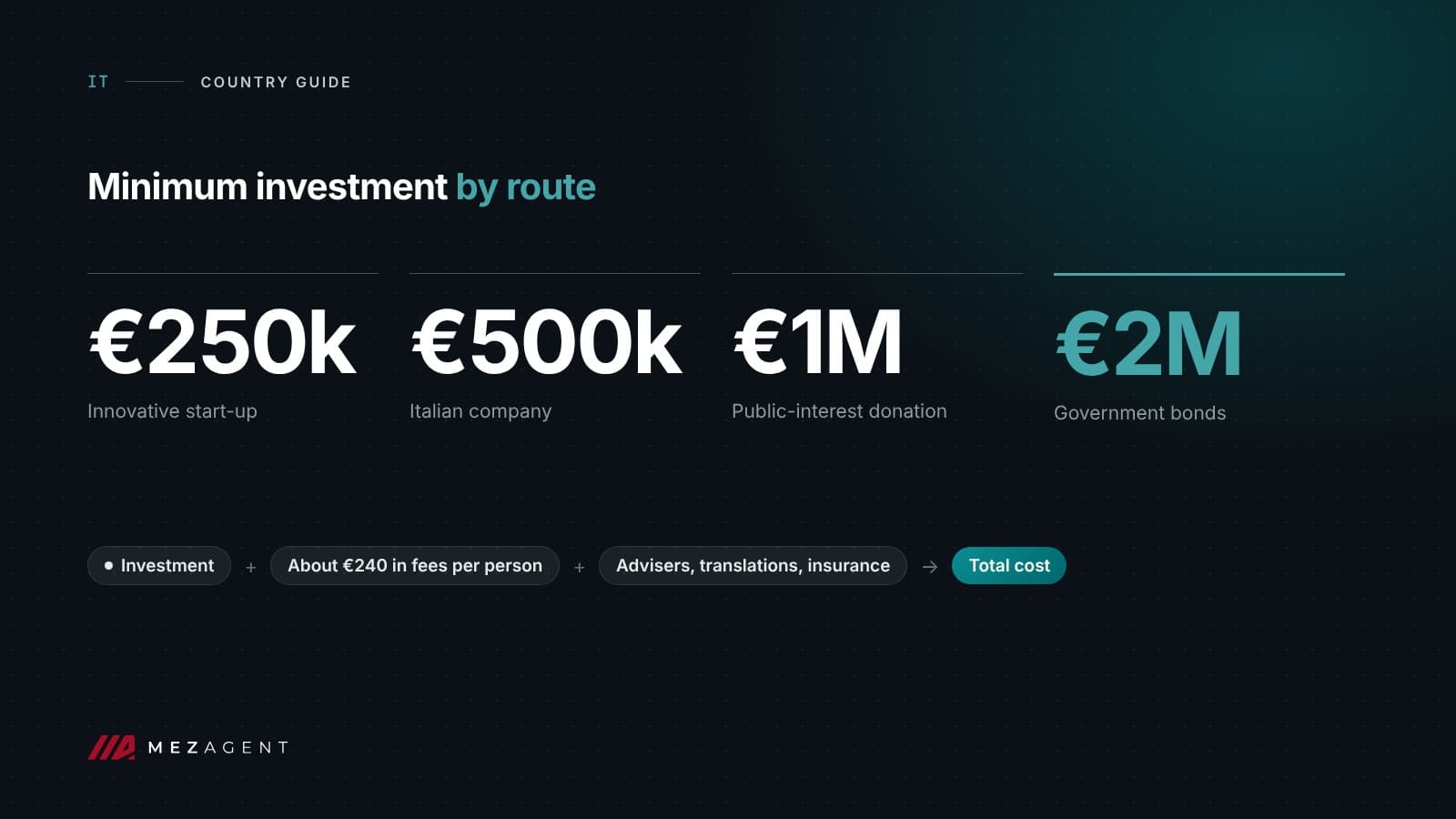
The cost of Italy's investor visa is mainly the qualifying investment, which depends on the route chosen, plus government and permit fees, legal and advisory fees, and costs such as translations and health insurance. The investment itself starts at EUR 250,000 for an innovative start-up and goes up to EUR 2 million for government bonds. Check current amounts on the official Investor Visa for Italy platform before relying on any figure.
Italy's golden visa is officially called the Investor Visa for Italy. It gives non-EU nationals a route to residence in exchange for a qualifying investment or donation. Unlike some other programmes in Europe, it does not include a real estate route.
This guide breaks down the full cost for applicants, and explains where advisers and introducers fit in. It is written for firms that serve investment migration clients and for the clients themselves. Figures in this post were checked in November 2026. Fees and procedures change, so confirm them on the official sites before relying on them.
Key Takeaways
- The main cost of Italy's investor visa is the qualifying investment, which starts at EUR 250,000 for an innovative start-up and rises to EUR 2 million for government bonds.
- There are four routes: government bonds, an Italian company, an innovative start-up, and a public-interest donation. There is no real estate route.
- Government visa and permit fees add up to roughly EUR 240 per person for a first permit, before professional fees, translations, legalisation and health insurance.
- The investment must be made within three months of entering Italy, and the first residence permit is valid for two years, renewable for a further three.
What Is the Italy Investor Visa?
The Investor Visa for Italy is a residence route for non-EU nationals who make a qualifying investment or donation in Italy. Applicants first obtain clearance, known as a nulla osta, from the Investor Visa for Italy Committee through the official platform. They then apply for the visa at an Italian consulate and, after arriving, for a residence permit.
The investment must be made within three months of entering Italy. The first residence permit is valid for two years and can be renewed for a further three years, as long as the investment is maintained. Renewal should be requested before the permit expires.
How Much Do You Need to Invest?
There are four main routes. The amounts below are those published by the Italian authorities, including on the Consulate General of Italy in London's investor visa page.
| Investment route | Minimum amount | What it involves |
|---|---|---|
| Italian government bonds | EUR 2,000,000 | Holding Italian state bonds for the required period |
| Italian company | EUR 500,000 | Investing in the capital of a company incorporated in Italy |
| Innovative start-up | EUR 250,000 | Investing in an Italian company registered as an innovative start-up |
| Public-interest donation | EUR 1,000,000 | A philanthropic donation to projects in areas such as culture, education, research or heritage |
What Are the Government and Permit Fees?
The bond route keeps the capital in a relatively low-risk asset, but needs the largest amount. The start-up route needs the least, but carries the risk of investing in a young company. The donation route is not recoverable.
Government fees are small compared with the investment, but they add up across a family. The main items are:
| Fee | Typical amount per person (November 2026) |
|---|---|
| National (type D) visa fee at the consulate | EUR 116 |
| Residence permit contribution, permit valid one to two years | EUR 50 |
| Electronic residence permit card | EUR 30.46 |
| Revenue stamp (marca da bollo) | EUR 16 |
| Postal application service | EUR 30 |
| Approximate total for a first permit | About EUR 240 |
What Professional Fees Should Applicants Expect?
Family members usually pay the same visa and permit costs for their own applications, and renewals carry permit costs again. The amounts are set by the Italian authorities and can change, so check the Polizia di Stato and your consulate before applying.
Most applicants use professional help, because the process runs across several Italian authorities and documents must meet strict formats. Typical professional costs include:
Legal or advisory fees for preparing the nulla osta application, the visa application and the residence permit
Investment structuring, for the company and start-up routes, including due diligence on the target company
Tax advice, because moving to Italy changes a person's tax position, and Italy offers optional tax regimes for some new residents
Banking and custody, for holding bonds or transferring funds
Fees vary widely between firms and depend on family size and the route chosen. Ask for a written quote that lists what is included.
What Other Costs Do Applicants Often Miss?
Several smaller costs are easy to overlook:
certified translations and legalisation or apostille of documents
proof of sufficient funds and source-of-funds documentation
health insurance for the visa application and the first period of residence
travel to the consulate and to Italy for the permit appointment
accommodation in Italy, which is needed for registration
ongoing accounting and reporting for the company or start-up route
Which Route Suits Which Applicant?
The cheapest route on paper is not always the cheapest in practice. Each route suits a different kind of applicant:
Government bonds suit applicants who want to keep capital in a low-risk asset and can commit the largest amount.
Italian company investment suits business owners or investors who want an active stake in the Italian economy and can manage company due diligence.
Innovative start-up investment suits applicants comfortable with venture-style risk in exchange for the lowest entry amount.
Philanthropic donation suits applicants for whom the donation itself is a goal, since the money is not returned.
Introducers and advisers who understand these differences can match clients to the right route early, which saves time and professional fees later.
What Does the Total Cost Look Like?
The table below summarises the cost categories. It does not give a single total, because the total depends almost entirely on the route chosen and the size of the family.
| Cost category | Typical scale | Recoverable? |
|---|---|---|
| Qualifying investment | EUR 250,000 to EUR 2,000,000 | Bonds and shares can be, donations cannot |
| Government visa and permit fees | About EUR 240 per person for the first permit | No |
| Legal and advisory fees | Varies by firm, route and family size | No |
| Translations, legalisation, insurance | Varies with the number of documents and family size | No |
| Ongoing costs (renewals, accounting) | Recurring | No |
Are There Yearly Costs?
Yes. Applicants need to maintain the investment, renew the residence permit when due and keep their documents in order. Company and start-up investors also face ongoing accounting and reporting costs. Tax obligations depend on whether the person becomes tax resident in Italy and which tax regime applies to them.
How Do Introducers and Advisers Fit In?
Most Italy investor visa clients do not start with a search engine. They start with a conversation with someone they already trust: a private banker, a tax adviser, a lawyer or a wealth manager.
For firms that handle Italy applications, those introducers are a steady source of well-prepared clients. For introducers, a clear referral agreement means the fee, the trigger and the payment period are agreed before the client is introduced. Our guide to referral fees vs commissions explains how these payments usually work, and our post on Golden Visa firms' cost per client from ads vs referral partners compares channels.
On MezAgent, investment migration firms receive introductions through a digital referral agreement, with each deal tracked by both sides and 0% platform commission. See our page for investment migration firms.
Frequently Asked Questions
How much does the Italy golden visa cost?
The main cost is the investment: EUR 250,000 in an innovative start-up, EUR 500,000 in an Italian company, EUR 1 million as a public-interest donation or EUR 2 million in government bonds. On top of that come government visa and permit fees of about EUR 240 per person, plus professional fees, translations and insurance. Check current figures on the official sites.
What are the investment options?
There are four routes: Italian government bonds, an investment in an Italian company, an investment in an innovative start-up, and a philanthropic donation to public-interest projects. There is no real estate route.
Are there yearly costs?
Yes. Applicants need to maintain the investment and renew the residence permit, and company or start-up investors have ongoing accounting costs. Tax costs depend on whether the person becomes tax resident in Italy and which regime applies.
The Bottom Line
Italy's investor visa is priced around the investment first and everything else second. The range runs from EUR 250,000 in an innovative start-up to EUR 2 million in government bonds, with a public-interest donation of EUR 1 million in between. Government fees of roughly EUR 240 per person are small next to that, but professional fees, translations and insurance are not.
Match the route to the applicant before discussing cost, keep the investment within the three-month window after entering Italy, and confirm every figure on the official platforms before relying on it.
Sources
This article is for general informational purposes only and is not legal, tax, or immigration advice. Rules vary by jurisdiction and change frequently. Consult a licensed professional before making decisions based on this content.
Free forever for professionals. No card required.
Sign up