Insights9 min read
Referral Fee vs Commission vs Introducer Fee vs Finder's Fee: What's the Difference?
The four terms get mixed up constantly, in contracts and on invoices. What each one means, who pays, and the typical ranges by sector.

Published 20 November 2026
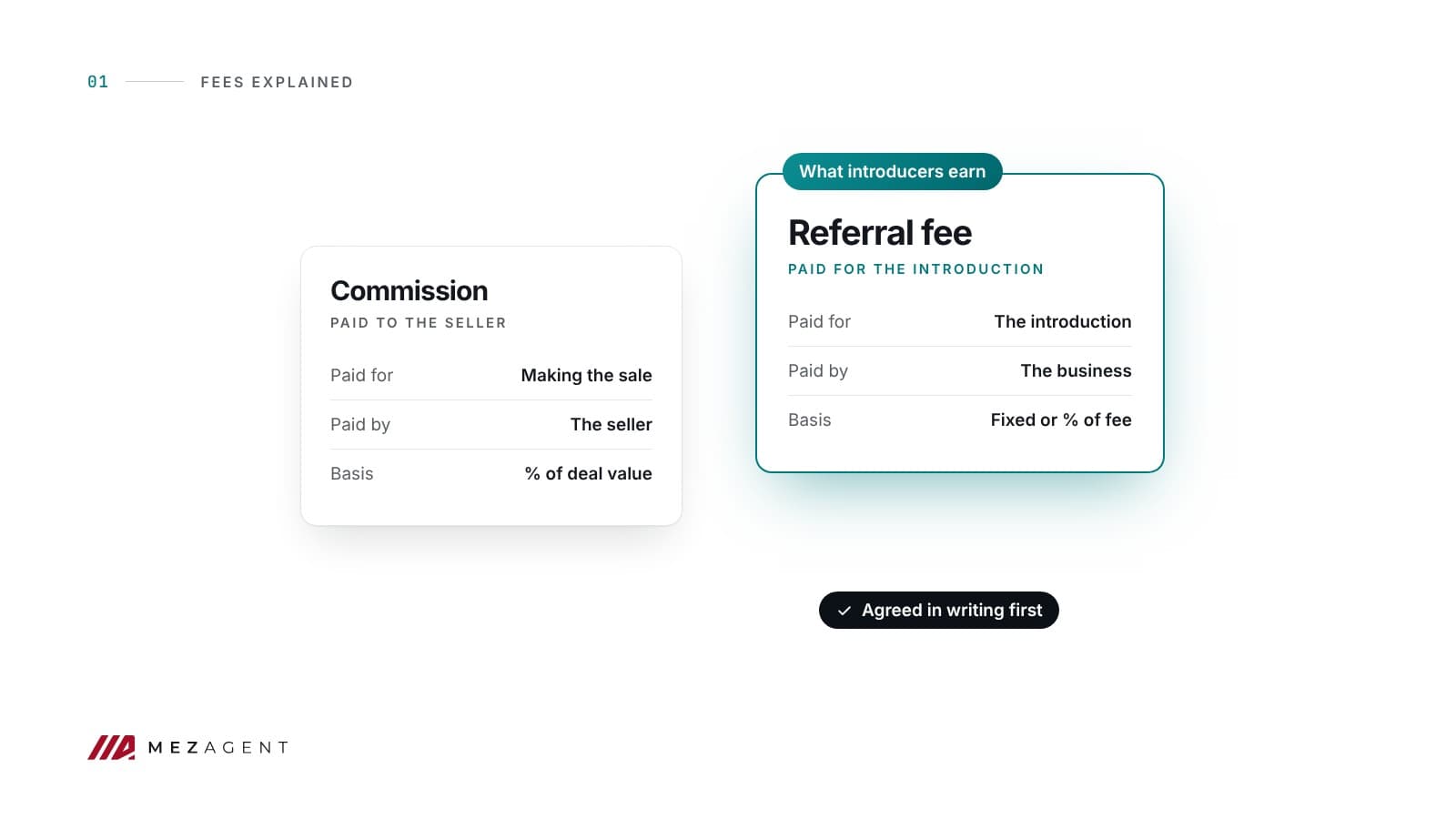
A referral fee is a payment for introducing a client to a business, usually a fixed amount agreed before the introduction. A commission is a percentage of the deal or service value. Introducer fee is the term UK finance and professional services tend to use for a referral fee, and finder's fee is the US and deal-making equivalent. Which one applies to you depends on what your agreement says.
The four terms get mixed up constantly, in conversations, contracts and even on invoices. That matters, because the label in the agreement decides how the payment is calculated, when it becomes due and, in some sectors, whether you are allowed to receive it at all.
This guide sets out what each term means, how they compare and how payments usually work in the cross-border sectors where MezAgent operates.
Key Takeaways
- A referral fee is a payment for an introduction, usually a fixed sum agreed in advance. A commission is a percentage of the deal or service value.
- Introducer fee and finder's fee describe the same idea in different markets: UK finance and professional services say introducer, while the US and deal-making say finder.
- The client is never the one paying. In all four arrangements, the business that receives the client pays the person who made the introduction.
- The label in the agreement decides how the payment is calculated, when it becomes due and, in some sectors, whether it can be paid at all.
What Is a Referral Fee?
A referral fee is a payment made by a business to the person who introduced a client to it. The person making the introduction is often called the introducer or referrer. The business receiving the client pays the fee. The client does not.
In most arrangements, the referral fee is a fixed sum agreed in advance. For example, a residency or citizenship firm may agree to pay an introducer a set amount for each client whose application goes ahead. A fixed fee is simple to agree and easy to check, which is why it is common in sectors where every client goes through a similar process.
The key point is that a referral fee rewards the introduction itself. The introducer does not usually advise the client on the service, negotiate the deal or carry out the work.
What Is a Commission, and How Is It Different?
A commission is a percentage of the value of a deal or a service. If the agreement says the introducer receives 2% of a property price, or 15% of a legal firm's fee, that is a commission.
The practical difference is that a commission moves with the size of the deal. A larger property sale or a bigger legal mandate means a larger payment. A fixed referral fee stays the same whatever the deal is worth.
Many people use referral commission loosely to mean any payment for an introduction. That is fine in conversation. In a written agreement, though, it is worth being precise: state whether the payment is a fixed amount or a percentage, and a percentage of what. We cover how percentage arrangements work in practice in our guide to earning referral commissions from your client network.
Introducer Fee and Finder's Fee: Are They the Same Thing?
Yes, in most cases they describe the same idea in different markets.
Introducer fee is the usual term in UK financial services, wealth management and professional services. A private bank or a law firm will often talk about introducers and introducer agreements.
Finder's fee is more common in the US and in deal-making, such as business sales, fundraising and investment transactions. The finder finds a buyer, investor or opportunity.
Both are payments for making an introduction. Both can be fixed or percentage-based. The label tells you more about the market and the paperwork tradition than about how the payment works.
How Do the Four Terms Compare?
The table below lines up the four terms on who pays, who receives, how the payment is calculated and where each term is usually used.
| Term | Who pays | Who receives | Fixed or % | Where you usually see it |
|---|---|---|---|---|
| Referral fee | The business that receives the client | The person who made the introduction | Usually fixed | Citizenship and residency programmes, professional services, general business referrals |
| Commission | The business that receives the client | The introducer or agent | Percentage of deal or service value | Property, legal and consulting fees, sales roles |
| Introducer fee | The firm that receives the client | The introducer | Fixed or % | UK finance, wealth management, law firms |
| Finder's fee | The party that gains the deal or investor | The finder | Fixed or % | US market, M&A, fundraising, business sales |
When Is a Referral Fee Due?
A referral fee or commission is normally due once the deal criteria in the agreement are met, not when the client first signs or first pays a deposit.
On MezAgent, those criteria are set out in a digital referral agreement before any client details are shared. For property deals, the trigger is usually the point at which an agreed share of the purchase price, for example 50%, has been transferred. For services such as legal or tax work, it is usually tied to the client engaging the firm and the agreed milestone being reached.
Once the criteria are met, businesses on MezAgent normally pay within two weeks. The exact terms are in each agreement, so always read the trigger and the payment period before you make the introduction. Our guide to how long it takes to get paid after you refer a client covers timing in more detail.
What Are Typical Referral Fee and Commission Ranges by Sector?
Ranges depend on the sector, the market and the size of the deal. These are the typical ranges we see in agreements on MezAgent:
| Sector | Typical arrangement on MezAgent |
|---|---|
| Legal and consulting services | 10 to 25% of the service fee |
| Property in mature markets (for example, the UK) | 2 to 3% of the purchase price |
| Property in growth markets (for example, Greece, Cyprus) | 7 to 10%, depending on new-build or resale |
| Rentals | A share of the agreed rent or letting fee |
| Citizenship and residency programmes | Often a fixed referral fee per client |
Why Do Some Sectors Restrict Payments to Unlicensed Introducers?
These are ranges, not promises. The figure in any single agreement depends on the business, the deal and what both sides agree. If you are on the business side, it also pays to meet introducers' expectations: an introducer who is paid fairly and on time is far more likely to bring the next client.
Some sectors limit who can receive a commission, or require the client to be told about it. The reason is usually consumer protection: regulators want to stop a payment from influencing advice the client relies on.
Financial advice in the UK. Advisers are covered by FCA rules on conflicts of interest and inducements. You can read the framework on the FCA website.
Solicitors in England and Wales. The SRA allows referral arrangements in many areas, with transparency rules, but referral fees are banned in personal injury cases. See the SRA Code of Conduct for Solicitors.
Estate agency. In several countries, including Greece, Cyprus and the UAE, acting as an estate agent requires a licence or registration. An introducer who only makes an introduction is in a different position from someone who markets property or negotiates deals.
Rules differ by country and by profession, and they change. Treat this section as an overview, not an answer for your situation. Our sector posts go into more detail, for example on whether UK and Cyprus law firms can pay referral fees to non-lawyers.
Do I Have to Pay Tax on a Referral Fee?
In most countries, a referral fee or commission is taxable income for the person who receives it. For the business paying it, the fee may count as a business expense if it is genuinely for the business and properly documented.
If you are in the UK, start with the government's guidance on working for yourself. We also cover whether you owe taxes on referral commission income and, for businesses, whether referral fees are tax deductible.
How Does MezAgent Handle Referral Fees and Commissions?
MezAgent is a referral platform that connects professionals who make introductions with businesses that welcome them. Whatever the fee is called, the structure is the same on the platform:
0% platform commission. MezAgent takes no cut of the referral fee or of the deal. The introducer receives what the agreement says.
A digital referral agreement first. The fee type, amount or percentage, trigger and payment period are agreed before any client details are shared.
Deal tracking for both sides. The introducer and the business can both see where the deal stands, so nobody has to chase updates by phone. You can read more on how MezAgent works.
Businesses on MezAgent are checked for reputation before they can post offers. That does not replace your own judgement, so it is still worth asking the right questions before your first introduction. Our list of questions to ask a referral partner is a good place to start.
Frequently Asked Questions
Is a referral fee the same as a commission?
Not quite. A referral fee is usually a fixed amount paid for an introduction. A commission is a percentage of the deal or service value. People often use the words interchangeably, so check the agreement to see which one applies.
Who pays the referral fee, the client or the business?
The business that receives the client pays the referral fee. The client does not pay the introducer. If a client is asked to pay an introducer directly, that is a different arrangement and may bring different rules.
Can a referral fee be a percentage?
Yes. Many agreements set the fee as a percentage of the deal or service value, which is technically a commission. Fixed referral fees are common for citizenship and residency programmes, while property and professional services often use percentages.
The Bottom Line
Four terms, one underlying arrangement: someone makes an introduction, and the business that receives the client pays for it. The label in the agreement decides whether that payment is a fixed referral fee, a percentage commission, an introducer fee or a finder's fee, and it decides when the money becomes due.
Before you agree terms, check which term the agreement actually uses, whether the payment is fixed or a percentage of something, and what trigger releases payment. The client should never be the one paying.
This article is for general informational purposes only and is not legal, tax, or immigration advice. Rules vary by jurisdiction and change frequently. Consult a licensed professional before making decisions based on this content.
Free forever for professionals. No card required.
Sign up