An immigration consultant in Houston gets a call most weeks from someone who needs an EB-5 filing, a complex asylum case, or a Golden Visa introduction abroad. She isn’t a lawyer. Under Texas rules, and under most states’ rules, she legally cannot prepare that filing or argue that case. She still built the relationship, still qualified the lead, and still has to decide what happens next. Does she just hand the client off for nothing? Most consultants in this position don’t, and they shouldn’t have to.
This guide walks through how immigration consultants actually monetize a client they can’t personally serve. It covers what a consultant legally is, why that status limits the fee structures available, and which arrangements hold up when a licensed firm takes the case. It also covers the mistakes that turn a reasonable referral fee into a bar complaint.
Key Takeaways
- Immigration consultants are defined by state law as non-lawyers who cannot practice law. That status, not preference, is what shapes every fee structure available to them.
- California’s Business and Professions Code Chapter 19.5 requires a $100,000 bond and a written contract disclosing non-lawyer status before an immigration consultant can even take a case (California Legislative Information, Business and Professions Code Section 22443.1, retrieved 2026-07-08).
- ABA Model Rule 1.5(e) lets lawyers split fees with other lawyers under specific conditions, but a non-lawyer referral source generally cannot receive a percentage of the legal fee itself.
- A flat referral fee, paid from the receiving firm’s business development budget rather than carved from the legal bill, is the most common compliant structure consultants use.
What Exactly Is an Immigration Consultant, Legally?
An immigration consultant is a non-lawyer who provides non-legal help on immigration matters, such as filling out forms, translating documents, or making a referral to an attorney. California defines the role this way under Business and Professions Code Section 22441, and several other states use nearly identical language. The title sounds close to “immigration lawyer” in casual conversation. Legally, the two have almost nothing in common.
That distinction carries real weight. In 2026, California still requires immigration consultants to post a $100,000 bond with the Secretary of State before operating, and their client contracts must state in bold text that the consultant is not an attorney (California Legislative Information, Business and Professions Code Section 22443.1, retrieved 2026-07-08). A consultant who ignores that boundary risks prosecution for the unauthorized practice of law, not just a lost client relationship. Every fee-earning structure a consultant can legally use starts from this baseline: they can advise on paperwork, not law, and that limit follows them into every referral conversation.
This is also exactly why referral work exists as a business line for consultants at all. A consultant who understands their own boundary clearly tends to build a more durable referral pipeline than one who quietly stretches into legal advice hoping nobody notices. Attorneys refer future cases back to consultants who stay inside their lane, not ones who create liability exposure.

Why Can’t a Consultant Just Take a Cut of the Legal Fee?
A consultant generally cannot take a straight percentage of the attorney’s legal fee because they aren’t a lawyer, and most fee-splitting rules apply specifically to lawyer-to-lawyer arrangements. ABA Model Rule 1.5(e) allows a division of fees between lawyers in different firms only when the split is proportional to work performed, or each lawyer assumes joint responsibility for the case, and the client consents in writing (American Bar Association, Rule 1.5: Fees, retrieved 2026-07-08). A consultant referring the case doesn’t perform legal work and can’t assume professional responsibility for the filing, so that pathway is closed by design.
This isn’t a loophole regulators overlooked. It exists specifically to prevent non-lawyers from profiting off legal fees without accountability for the legal work itself. A financial advisor, real estate agent, or immigration consultant taking a cut of legal fees would create exactly the incentive structure bar associations built Rule 5.4 to prevent: steering clients toward whichever attorney pays the biggest kickback, regardless of fit. Firms building referral partner networks through MezAgent have told us the confusion here rarely comes from bad intent. Most consultants genuinely assumed a flat fee and a percentage fee were interchangeable options, until a receiving firm’s compliance counsel flagged the difference mid-negotiation.
The workaround most firms and consultants land on is a flat fee, structured as compensation for the introduction itself rather than a slice of billed legal work. How Referral Commissions Work for Immigration and Golden Visa Introductions covers this mechanism as it applies across the whole referral ecosystem, not just consultants.
What Fee Structures Do Consultants Actually Use?
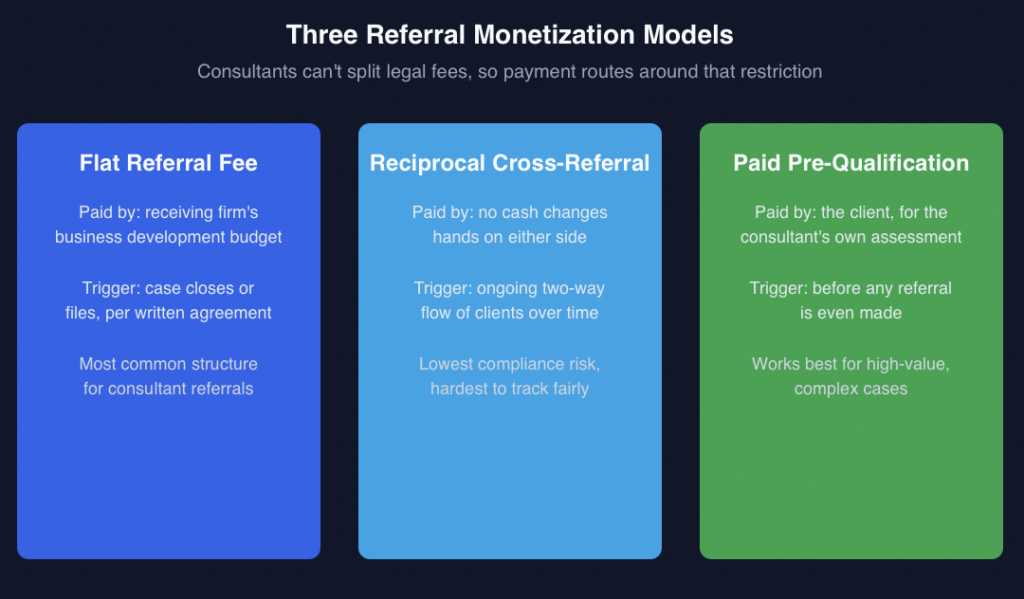
Consultants monetizing a referred case they can’t serve typically use one of three structures: a flat referral fee paid outside the legal bill, a reciprocal cross-referral arrangement, or a paid pre-qualification service billed directly to the client before any referral happens. Each has a different risk profile, and firms tend to prefer different ones depending on case size and jurisdiction.
The flat fee is the most common. The receiving law firm pays it from its own business development budget once the case closes, rather than deducting it from the client’s legal bill. That keeps the payment structurally separate from the fee the client actually owes the attorney, which is the distinction regulators care about. A reciprocal arrangement works differently: instead of cash, the consultant and the attorney simply send business back and forth over time, with no money changing hands on any single case. For example: a consultant in Miami who regularly encounters EB-5 cases beyond her scope sends them to a securities-focused immigration firm. That firm, in turn, refers back routine visa renewals and form-preparation work well within her lane. Neither side invoices the other for any single introduction.
The third option, paid pre-qualification, sidesteps the fee-sharing question entirely. The consultant charges the client directly for an assessment of their case and eligibility, then makes an unpaid referral to whichever attorney fits. This works best for high-net-worth clients who expect to pay for expert triage regardless of where the case eventually lands.
Is a Flat Referral Fee Better Than a Percentage Fee?
A flat referral fee is generally the safer choice for a non-lawyer consultant, since it avoids the appearance of splitting a legal fee at all. A percentage fee tied directly to the attorney’s bill invites exactly the scrutiny Rule 5.4 exists to apply. That said, “safer” doesn’t mean “always allowed everywhere.” State bar interpretations vary, and a structure that’s routine in one state can draw a formal ethics inquiry in another.
Flat fees also tend to be easier to negotiate up front, because both sides know the number before the case even starts moving. A percentage arrangement leaves the consultant guessing at what the final legal bill will look like, particularly on a case that could resolve in three months or drag on for two years. On a complex investor visa case, that unpredictability cuts both ways. The consultant might end up underpaid relative to the effort of the introduction, or the firm might balk at a percentage that grows unexpectedly large as the case gets more complicated than initially scoped.
Referral relationships tracked on MezAgent between non-lawyer consultants and immigration law firms show flat-fee arrangements settle faster after a case closes than percentage-based ones do, mainly because there’s no invoice to reconcile against a final legal bill. That single point of friction, waiting on a final number before anyone can calculate a percentage, is usually what delays payment on the alternative structure.
How Do Consultants Avoid Crossing Into Unauthorized Legal Practice?
Consultants avoid unauthorized practice of law by staying strictly on the non-legal side of every client interaction, even while actively working a referral relationship. That means no interpreting immigration statutes for a client, no predicting case outcomes, and no drafting legal arguments, even informally over the phone. The moment a consultant tells a client what the law requires rather than what forms exist, they’ve crossed a line regulators actively enforce.
The American Bar Association has published specific guidance warning that unauthorized immigration practice causes real harm. Victims face financial loss and, in the worst cases, deportation consequences from bad advice dressed up as consulting (American Bar Association, “Avoiding the Unauthorized Practice of Immigration Law,” retrieved 2026-07-08). That’s a strong signal for why firms accepting consultant referrals scrutinize how the consultant describes the firm’s services to prospective clients before agreeing to any ongoing relationship.
The practical boundary that keeps most consultants safe is simple: talk about the client’s situation and paperwork, not the law. “You’ll need to gather these documents for your I-140” is fine. “You’ll qualify under this exception to the public charge rule” isn’t, unless a licensed attorney is the one saying it. Consultants who keep referral conversations focused on logistics rather than legal interpretation rarely run into trouble, and they protect the very referral relationship that pays them.

Should the Referral Agreement Be in Writing?
Yes. A written referral agreement should exist before a consultant sends a single client, defining the fee amount, the trigger for payment, and what happens if the case doesn’t close. Verbal understandings tend to work fine right up until there’s a disagreement about what “the deal” actually was, at which point neither side has anything to point to. That gap gets worse the longer a case takes to resolve, and immigration cases routinely stretch past a year.
A workable agreement typically nails down four things. First, what counts as a qualifying referral, since not every phone call should trigger a fee obligation. Second, the specific dollar amount or fee percentage, spelled out as a number rather than a vague “we’ll figure it out later.” Third, the payment trigger: filing, approval, or the case physically closing out. Fourth, what happens on a denial, since most standard agreements pay nothing if the underlying case is denied.
Rather than negotiating this from scratch every time, some consultants keep a standard referral agreement template they present to every new firm relationship, adjusting only the fee number. That consistency prevents the kind of memory-contest dispute that shows up when two parties recall a handshake deal differently six months later.
What Happens When a Consultant Refers the Same Client to Multiple Firms?
Sending the same client to more than one firm at once creates a fee dispute risk that a single-firm referral doesn’t. Two firms can each believe they earned the fee if the client eventually signs with a shared network connection, and sorting out who introduced the client first gets messy without a timestamped record. Consultants juggling multiple firm relationships face this exact scenario more than they might expect, especially when working niche cases that only a handful of specialist firms handle well.
This doesn’t mean parallel referrals are automatically wrong. Sometimes a case genuinely benefits from more than one firm’s input, particularly a complex case straddling more than one visa category. It does mean the consultant needs to be transparent with every firm involved, rather than quietly shopping the same client around and hoping nobody compares notes. Firms that discover this after the fact tend to stop prioritizing that consultant’s future introductions.
Frequently Asked Questions
Can an immigration consultant legally earn a commission for referring a client to a lawyer?
Yes, but generally not as a percentage of the attorney’s legal fee. A flat referral fee, paid separately from the client’s legal bill, is the structure most consultants and firms use. Taking a direct cut of legal fees runs into rules like ABA Model Rule 5.4, which restricts fee-sharing between lawyers and non-lawyers in most states.
What’s a typical referral fee an immigration consultant can expect?
Flat fees vary by case complexity and jurisdiction, and no single national standard exists. Consultants and firms typically negotiate a specific dollar amount tied to the introduction itself, spelled out in a written agreement before any client is referred, rather than relying on an industry-wide percentage benchmark.
Does a consultant get paid if the referred case gets denied?
Usually not. Most referral agreements pay a fee only once the case closes successfully, mirroring how referral fees generally work across professional services. Some agreements include a partial fee for cases that fail for reasons outside anyone’s control, but that has to be spelled out in writing beforehand.
Is it illegal for an immigration consultant to give legal advice while making a referral?
Yes, in nearly every state. An immigration consultant can only provide non-legal help, such as form preparation or translation. Interpreting immigration law or predicting case outcomes crosses into unauthorized practice of law, which carries real legal consequences separate from any referral fee dispute.
The Bottom Line
Immigration consultants monetize the clients they can’t personally serve by structuring compensation around the introduction itself, not around a cut of legal work they’re not licensed to perform. A flat referral fee, paid from a receiving firm’s business development budget, is the model that holds up best against non-lawyer fee-sharing restrictions. Reciprocal cross-referrals and paid pre-qualification services round out the other common structures. None of this works reliably without a written agreement defining the fee, the trigger, and what happens on a denial.
The underlying constraint never really changes: a consultant’s non-lawyer status limits which fee structures are even on the table. Understanding that boundary early prevents the kind of dispute that shows up months into a referral relationship, once someone finally writes the actual number down.
Sources
- California Legislative Information, “Business and Professions Code, Section 22443.1 (Chapter 19.5: Immigration Consultants),” retrieved 2026-07-08. https://leginfo.legislature.ca.gov/faces/codes_displayText.xhtml?lawCode=BPC&division=8.&chapter=19.5.
- American Bar Association, “Rule 1.5: Fees,” retrieved 2026-07-08. https://www.americanbar.org/groups/professional_responsibility/publications/model_rules_of_professional_conduct/rule_1_5_fees/
- American Bar Association, “Avoiding the Unauthorized Practice of Immigration Law,” retrieved 2026-07-08. https://www.americanbar.org/groups/public_interest/immigration/projects_initiatives/fightnotariofraud/avoiding-the-unauthorized-practice-of-immigration-law/
This article is for general informational purposes only and is not legal or immigration advice. Referral fee rules, unauthorized practice of law restrictions, and immigration consultant licensing requirements vary by state and change frequently. Consult a licensed immigration attorney or your state bar’s ethics counsel before entering into or relying on any referral arrangement described here.