Two agents each believe they referred the same buyer. One sent an introduction in March. The other swears the client called them directly in June, with no mention of anyone else. The deal closes in September. Now a $9,000 fee is sitting in escrow, and nobody wants to release it until someone decides who actually gets credit.
This is one of the more common disputes in property referral work, and it rarely gets resolved by who’s more convincing on the phone. It gets resolved by whoever has a timestamped record. This guide covers how property businesses actually handle referral credit disputes: what causes them, how duplicate claims get sorted out, how split credit works when both sides have a real claim, and what to put in place so the next dispute takes an hour instead of a month.
Key Takeaways
- Most referral credit disputes come down to timing evidence, not persuasiveness. The referral agreement date, first-contact record, and acceptance confirmation decide who gets paid.
- NAR’s Code of Ethics Article 17 requires REALTORS to arbitrate procuring-cause disputes rather than litigate them, using a documented evidentiary process (National Association of Realtors, 2026).
- When two agents both contributed meaningfully to a closed deal, brokerages increasingly split the fee rather than award it to one side outright, similar to how multi-touch attribution splits credit across marketing touchpoints.
- A shared, timestamped referral log prevents most disputes before they start. Verbal handoffs and single email threads are the weakest evidence in any credit dispute.
What Causes a Referral Credit Dispute in Real Estate?
A referral credit dispute happens when two parties both believe they’re owed a fee for the same closed transaction, and no single document settles the question on its own. It’s rarely about whether a referral happened. It’s about which one happened first, or whether an informal conversation counted as a referral at all.
Three patterns account for nearly every dispute a brokerage sees. The first is the duplicate claim: two agents each introduced the same buyer, independently, without knowing the other had already made contact. The second is the ghost referral: an agent sent a client’s name once, got no response, and assumed the conversation ended there, only for the client to resurface through a different agent months later. The third is scope disagreement, where one side thinks a referral fee covers the original introduction only, and the other side thinks it covers an entire relocation, including a second property the client bought a year later.
For example: an agent in Chicago refers a relocating client to a colleague in Austin in January. The colleague never confirms receipt in writing. The client goes quiet for four months, then reaches out to a different Austin agent they met through a coworker. That second agent closes the deal in July with no knowledge of the January referral. When the Chicago agent finds out, both Austin agents believe they’re the one owed nothing and the Chicago agent believes she’s owed everything. That’s a three-way dispute born from a referral that was never confirmed in writing.
Can You Refer a Client to Property in Another Country and Still Get Paid?.

How Do You Prove Who Gets Credit for a Duplicate Referral Claim?
You prove referral credit with a timestamped record showing when the introduction happened, not with a recollection of a phone call. Brokerages weigh three pieces of evidence above everything else: the date the referral agreement was signed or the introduction was logged, the date the client’s contact information actually reached the receiving agent, and whether the receiving agent confirmed acceptance in writing.
Order matters more than intent here. An agent who genuinely believes they introduced a client first, but has no record predating the other agent’s documented contact, has a much weaker claim than the paperwork suggests. This is uncomfortable for agents used to running referral relationships on trust, but it’s the same standard the industry already applies to a related question: who gets commission when two brokers both worked with the same buyer.
That related standard is called procuring cause, and real estate arbitration has used it for decades. A broker is regarded as the procuring cause of a sale if their efforts are the uninterrupted foundation on which the transaction was actually built, not simply the first point of contact (NAR, “Procuring Cause: An Introduction and Factors,” retrieved 2026-07-07). NAR’s Code of Ethics Article 17 requires REALTORS to arbitrate this exact category of dispute rather than sue each other over it, and arbitration panels work from a documented factor sheet rather than a gut call (National Association of Realtors, Code of Ethics and Arbitration Manual, 2026). Referral credit disputes borrow the same evidentiary posture. Whoever built the paper trail first tends to win, and whoever waited to document anything tends to lose regardless of how the conversation actually went.
The agents who lose these disputes almost never lose because their referral wasn’t real. They lose because their referral wasn’t written down anywhere with a date attached to it. A verbal handoff at a conference two years ago carries zero evidentiary weight against a signed agreement dated the same week.
What Cross-Border Property Buyers Expect From a Referring Agent.
What Happens When Two Agents Both Made a Real Contribution?
When both agents genuinely contributed to a closed deal, brokerages increasingly split the referral fee rather than award the full amount to one side. This shows up most often in the ghost-referral pattern: one agent made the original introduction, and a second agent did the actual work of re-engaging the client and walking them through the transaction months later.
Split-credit arrangements borrow a logic that will look familiar to anyone who has run a marketing attribution model. Digital marketing teams have long faced the same structural problem: a customer touches a brand multiple times before converting, and no single touchpoint deserves 100% of the credit. A U-shaped attribution model, for instance, commonly assigns 40% of the credit to the first touchpoint and 40% to the touchpoint that generated the lead, splitting the remaining 20% across everything in between (Twilio, “Multi-Touch Attribution: What It Is and How to Do It Right,” retrieved 2026-07-07). Real estate brokerages resolving a genuine dual-contribution dispute apply the same basic idea in miniature, usually settling on something like a 60/40 or 70/30 split rather than an even divide, weighted toward whichever agent’s work was closer to the actual closing.
There’s no single industry-standard percentage for this, and any agent-to-agent split has to be negotiated and documented before the fee is paid out, not decided informally after the money is already in escrow. What matters is that a split gets proposed at all instead of defaulting to a winner-take-all fight. A 65/35 split both sides accept resolves a dispute in a week. A full-credit argument neither side will concede can drag on for months and damage two working relationships in the same brokerage community.
For example: the Chicago-to-Austin scenario above resolved with a negotiated split once all three agents compared records. The original Chicago referral had a dated agreement but no confirmed acceptance. The second Austin agent had done all the closing work but no original introduction. The brokerages settled on a 30/70 split favoring the agent who closed the deal, with the smaller share going to the agent who made first contact. Neither side got what they initially asked for, but neither side walked away with nothing either.
Should You Refer a Client Retiring From Real Estate or Keep the Deal?.

How Should a Referral Dispute Actually Get Resolved, Step by Step?
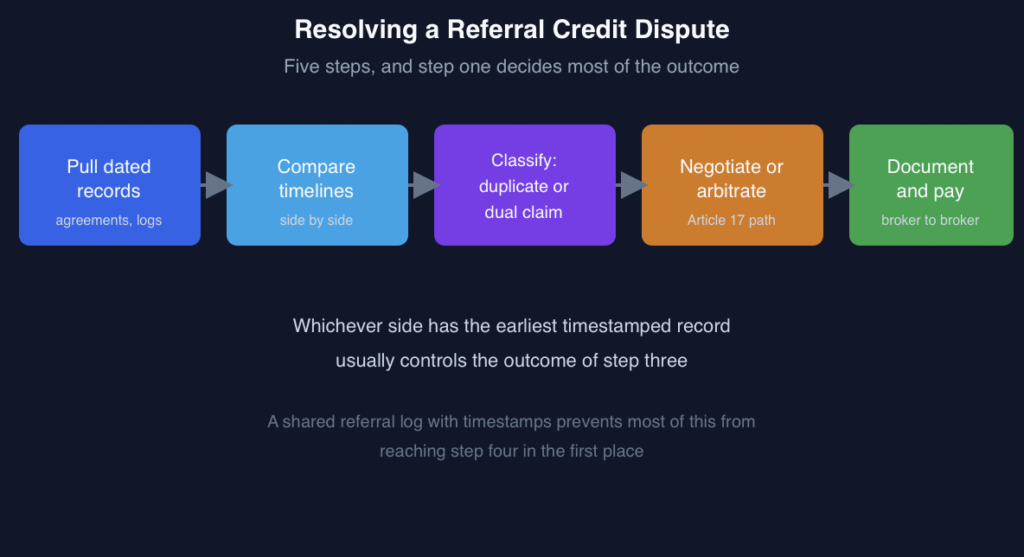
Most referral credit disputes resolve through a five-step process, whether the brokerages involved realize they’re following one or not. Skipping a step tends to be exactly where a dispute stalls out.
- Pull every dated record. Both sides gather the referral agreement, the first-contact timestamp, any written acceptance, and CRM or system logs showing when the client’s information moved between agents.
- Compare timelines side by side. Lay out both records chronologically rather than arguing from memory. This step alone resolves a surprising number of disputes, because one timeline usually turns out to have a clear gap the other side didn’t know about.
- Determine whether this is a duplicate claim or a dual-contribution case. If only one side has a documented, timestamped referral, the dispute usually ends here. If both sides genuinely contributed at different points in the client’s journey, move to negotiation instead.
- Negotiate or arbitrate the split. Brokerages settle most of these directly, agent to agent, with each firm’s broker involved. When agents can’t agree, NAR’s Code of Ethics Article 17 requires the dispute to go through mediation first, then arbitration, rather than litigation (National Association of Realtors, 2026).
- Document the resolution and pay through the brokerages. Once a split or a full award is agreed, it gets written down and paid broker to broker, the same way any referral fee is supposed to move in the first place.
Across referral relationships tracked on MezAgent, the disputes that resolved fastest were the ones where both sides could produce a timestamped record within minutes of being asked. The disputes that dragged on for weeks were consistently the ones where at least one side had to reconstruct their timeline from old emails and memory after the fact.
Real Estate Referral Commissions: How Agents Get Paid for Property Introductions.
Can a Tracking System Actually Prevent These Disputes?
Yes, a shared referral tracking system prevents most credit disputes before they happen, because it removes the single biggest point of failure: an introduction that only exists in one person’s inbox or memory. When every referral gets logged the moment it’s made, with a timestamp neither side controls after the fact, there’s rarely a question left to argue about.
The mechanics matter here, and they’re the same mechanics that show up anywhere businesses need to tell two similar-looking records apart. Deduplication systems typically flag potential duplicate contacts by matching on fields like phone number, email, or name, then apply a similarity threshold before treating two records as the same person. Salesforce’s own duplicate-management documentation describes this as fuzzy matching, tolerant of minor formatting differences, with a threshold typically set in the 80% to 90% similarity range before an automatic match gets flagged for review (Salesforce, “Standard Lead Duplicate Rule,” retrieved 2026-07-07). Applied to real estate referrals, the same logic flags when two agents have logged contact information for what looks like the same client, before a dispute ever gets to the point of two brokerages arguing over it months later. Vendors’ own published matching thresholds vary by implementation and data quality, so treat any specific accuracy figure as directional rather than a guaranteed number for every dataset.
That’s a meaningfully different posture than resolving a dispute after the fact. A system flags the overlap in week one, not month nine, and the two agents can sort out who made contact first while the details are still fresh and the deal hasn’t closed yet.
What Cross-Border Property Buyers Expect From a Referring Agent.

Duplicate Claim vs. Split Credit at a Glance
| Scenario | What it looks like | How it typically resolves | What decides it |
|---|---|---|---|
| Duplicate referral claim | Two agents each believe they independently introduced the same client | One side’s documented, timestamped referral prevails | Earliest verifiable record of introduction |
| Ghost referral resurfacing | Referral goes quiet, client reappears through a different, unrelated agent | Often resolves as a dual-contribution split | Whether the original referral was ever confirmed in writing |
| Scope disagreement | Both sides agree a referral happened, but disagree what it covers | Clarified against the original agreement’s wording | The written scope in the referral agreement itself |
| Genuine dual contribution | Both agents did real, separate work that led to the eventual close | Negotiated split, often weighted toward the closing agent | Proportional contribution, agreed in writing before payout |
Frequently Asked Questions
Who gets credit when two real estate agents both claim the same referral?
Credit typically goes to whichever agent has the earliest verifiable, timestamped record of the referral, such as a signed agreement or a logged first-contact date. Real estate arbitration applies a similar standard, called procuring cause, when two brokers dispute who is entitled to a commission on the same closed sale.
Is there an industry-standard split-credit percentage for real estate referrals?
No single standard percentage exists. Brokerages negotiating a genuine dual-contribution dispute often land somewhere between 60/40 and 70/30, weighted toward whichever agent’s work was closer to the actual closing, but every split has to be negotiated and documented case by case.
Do real estate referral disputes go to court?
Rarely, if both agents are REALTORS. NAR’s Code of Ethics Article 17 requires REALTORS to arbitrate contractual and procuring-cause disputes with each other through their local board rather than litigate them, using a documented evidentiary process instead of a lawsuit.
What’s the single best way to prevent a referral credit dispute?
Log every referral in a shared, timestamped system the moment it happens, rather than relying on a verbal handoff or a single email. Most disputes that drag on for weeks involve at least one side reconstructing their timeline from memory after the fact, instead of pointing to a record that already existed.
What is procuring cause and how does it relate to referral disputes?
Procuring cause is the doctrine real estate arbitration uses to decide which broker’s efforts were the actual foundation of a closed sale, when more than one broker was involved. Referral credit disputes apply the same underlying logic: whoever can show their contribution actually led to the transaction, backed by dated evidence, tends to prevail.
The Bottom Line
Referral credit disputes in real estate almost never come down to who’s telling the truth. They come down to who can produce a dated record first. NAR’s own arbitration framework under Article 17 exists because this exact category of disagreement is common enough to need a standing process, not a one-off negotiation every time. Split-credit resolutions are becoming more common for the genuine dual-contribution cases, borrowing the same logic marketing teams use to divide credit across multiple touchpoints. None of it replaces the simplest fix: log the referral the day it happens, in a system both sides can check later.
Building referral tracking for property businesses at MezAgent, the pattern that comes up again and again isn’t agents acting in bad faith. It’s two people who both remember the same relationship differently, months apart, with nothing written down to settle it. The fix is almost never a better argument. It’s a shared record that existed before anyone needed to argue at all.
Sources
- National Association of Realtors, “Case Interpretations Related to Article 17,” Code of Ethics and Arbitration Manual, 2026, retrieved 2026-07-07. https://www.nar.realtor/code-of-ethics-and-arbitration-manual/case-interpretations-related-to-article-17
- National Association of Realtors, “Procuring Cause: An Introduction and Factors,” retrieved 2026-07-07. https://www.nabor.com/page-data/files/pages/pro-standards/mediation-and-arbitration-dispute-desolution/NARs-procuring-cause-ntro-and-factors.pdf
- Twilio, “Multi-Touch Attribution: What It Is and How to Do It Right,” retrieved 2026-07-07. https://www.twilio.com/en-us/resource-center/an-introduction-to-multi-touch-attribution
- Salesforce, “Standard Lead Duplicate Rule,” Salesforce Help, retrieved 2026-07-07. https://help.salesforce.com/s/articleView?id=sales.duplicate_rules_standard_lead_rule.htm&language=en_US&type=5
This article is for general informational purposes only and is not legal, tax, or real estate advice. Referral dispute outcomes depend on the specific facts, agreements, and jurisdiction involved. Consult a licensed real estate attorney or your local REALTOR association’s professional standards committee before relying on any process described here.