A property agent in Dubai introduces a client to a Portuguese immigration firm. Eight months later, the fund-based Golden Visa application gets denied over a documentation issue nobody caught early. The agent did the work: qualifying the client, making the introduction, staying available through the process. Now they want to know if any of that translates into a payment. There’s no industry-wide statistic that answers this, because nobody publishes rejection-linked referral fee data. What does exist is a well-established legal principle that answers the question anyway: contingent fees are tied to a defined outcome, not to effort spent along the way.
This piece walks through why that principle applies here, what “no commission on denial” actually means in practice, and where the real disputes come from.
Key Takeaways
- Most referral agreements pay nothing if the visa or Golden Visa application is denied, because the fee is contingent on a defined outcome rather than on the introduction itself.
- No public benchmark tracks referral-commission-loss rates tied to visa rejections. This is a structural, contract-driven question, not a statistical one.
- Contingent fee logic in the legal profession, governed by rules like ABA Model Rule 1.5, already establishes that a fee tied to an outcome is not earned until that outcome happens.
- Disputes after a rejection almost always trace back to an agreement that never defined what “closed” or “successful” means.
- A referring party’s own conduct, accurate qualification versus misrepresented eligibility, usually decides whether a partial fee is even on the table.

Do You Lose Your Referral Commission If the Visa Gets Denied?
In nearly every standard referral agreement, yes, you lose the commission if the underlying application is denied, because the fee was never earned on the introduction alone. It was earned on a specific outcome the agreement defines, and a rejection means that outcome didn’t happen. This isn’t a punitive rule aimed at referring parties. It’s the same logic used across professional-services referrals generally: the receiving firm doesn’t collect its full fee either, so there’s nothing left to split.
Where people get tripped up is assuming “referral fee” means payment for the act of connecting two parties. In immigration and Golden Visa work specifically, that’s rarely how the agreement is written. How Referral Commissions Work for Immigration and Golden Visa Introductions covers the baseline mechanics this spoke builds on. The short version: the fee is contingent, and contingent means tied to success.
Why Do Immigration Referral Fees Work Like Contingent Fees?
Immigration referral fees function like contingent fees because the entire chain of payment starts with the receiving firm’s own engagement terms, and most immigration and Golden Visa engagements are themselves priced around defined milestones or outcomes, not open-ended hourly billing. If the firm doesn’t get paid, or gets paid less because the case failed, there’s structurally less for a referral fee to draw from.
This mirrors a much older and better-documented practice: contingent fee arrangements in litigation. Under the American Bar Association’s Model Rule 1.5, a lawyer’s fee can be contingent on the outcome of a matter, except where contingent fees are specifically prohibited, such as in criminal defense or most domestic relations cases (American Bar Association, “Rule 1.5: Fees,” retrieved 2026-07-08). The rule requires the agreement to spell out, in writing, exactly how the fee is calculated and what happens at each possible outcome. That’s the entire point of a contingent structure. Payment is tied to a result the parties agreed on in advance, not to hours logged or effort demonstrated.
Referral commissions in immigration work borrow that same skeleton, even when no lawyer is involved on the referring side. The reasoning transfers cleanly: if the underlying professional’s own fee depends on an outcome, a referral fee layered on top of that engagement almost always depends on the same outcome. Nobody has published a rejection-linked referral loss rate for this niche, and it would be difficult to construct one honestly. Every firm defines “success” differently, tracks denials differently, and few disclose fee outcomes publicly at all. What we can say with confidence is structural: the contingent-fee principle that governs adjacent, well-documented legal fee arrangements applies with equal logic here.
What If the Rejection Wasn’t Anyone’s Fault?
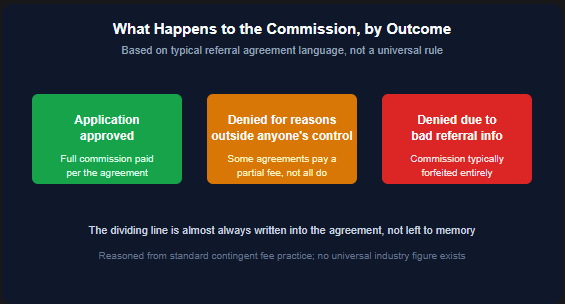
If a visa or Golden Visa application is denied for reasons genuinely outside anyone’s control, a policy change mid-application, a processing backlog, a documentation requirement that shifted after filing, the outcome for the referral fee depends entirely on what the agreement says. Some firms build in a partial fee for exactly this scenario, recognizing that the referring party did legitimate work and the case failed for reasons nobody could have predicted. Others don’t, and treat any non-approval the same way regardless of cause.
Neither approach is wrong on its face. It’s a negotiated term, not a legal requirement. In conversations with firms building referral partner programs through MezAgent, the ones with the fewest disputes are consistently the ones that addressed this scenario in writing before the first case ever got filed, not after a denial forced the conversation. Waiting until a rejection happens to decide whether a partial fee applies puts both sides in a position where the answer feels arbitrary, even when it isn’t.
For example: a wealth manager refers a client for a Golden Visa fund investment route. The application is filed correctly and the client meets every documented requirement. Nine months later, a government-side backlog and a subsequent rule change push the application past a new eligibility cutoff, and it’s denied on a technicality nobody could have foreseen at filing. The referral agreement in this case specifies a 30% partial fee for denials attributable to regulatory changes after filing. The wealth manager receives that partial payment. Had the agreement been silent on this scenario, the outcome would have been a negotiation, not a formula.
Does It Matter Why the Client Was Referred If the Case Fails?
Yes, and this is where most disputes actually originate. If a rejection traces back to inaccurate information the referring party provided, misstated income, an omitted prior visa denial, an eligibility category the client didn’t actually qualify for, most agreements treat that as forfeiting the referral fee entirely, and that allocation of risk is reasonable. The referring party’s core value proposition is qualification. A firm pays for accurate leads, not for volume. A referral that actively misrepresents a client’s eligibility isn’t just unpaid work, it’s work that cost the firm time and reputation.
This distinction matters more in Golden Visa referrals than in a typical domestic visa case, because the stakes and the diligence period are both larger. What Immigration Law Firms Look for in a Referral Partner goes into what firms actually check before they trust a referring party’s qualification work. A referring party who consistently sends accurate, well-vetted introductions builds exactly the track record that keeps a firm paying out partial fees on close calls. One who doesn’t, loses that benefit of the doubt fast.

How Should “Success” Be Defined in a Referral Agreement?
A referral agreement should define success as a specific, checkable event, filing, approval, or visa issuance, stated explicitly, because vague language is the single biggest source of post-rejection disputes. “Closed” can mean three different things to two different people: the application was filed, the application was approved, or the visa was physically issued and the client relocated. An agreement that never picks one of these leaves the referring party and the firm negotiating from scratch the moment a case doesn’t go smoothly.
Immigration and Golden Visa cases add a real complication here that a faster-moving referral vertical doesn’t have. These cases commonly run six months to well over a year between introduction and final decision. That gap is long enough for memories to soften and for informal understandings to drift. A written definition of the qualifying event, set before the case starts, removes the ambiguity before it can turn into a disagreement.
For example: two referral agreements cover functionally identical Golden Visa introductions. One specifies the commission triggers “on approval of the application by the relevant government authority.” The other only says the fee is paid “on a successful case.” When both applications get denied after an eighteen-month wait, the first referring party has no ambiguity to argue about, the trigger event plainly didn’t happen. The second referring party spends weeks in an uncomfortable conversation about what “successful” was ever supposed to mean.
Can You Negotiate for Partial Payment on a Rejected Case?
You can negotiate for partial payment on a rejected case, and doing so before any case is filed is far more effective than doing it after a denial has already happened. Once a specific case is denied, the negotiation becomes adversarial by default: one party is arguing they’re still owed something, and the other is arguing the trigger event never occurred. Before any case exists, the same conversation is just contract drafting.
Reasonable structures worth proposing upfront include a flat, smaller “introduction fee” paid regardless of outcome, layered under a larger success-based commission if the case closes. Another option is a defined partial percentage specifically for denials attributable to circumstances outside anyone’s control, distinct from denials caused by referral error. Referral relationships tracked on MezAgent that specified a partial-fee clause for no-fault denials in writing, before the first case was filed, showed far fewer post-rejection payment disputes than relationships operating on a verbal or one-line understanding of “we’ll figure it out if it doesn’t work out.” The clause itself, not its generosity, is what prevents the dispute.
A Referral Outcome Comparison at a Glance
| Rejection scenario | Typical commission outcome | What usually decides it |
|---|---|---|
| Application denied, no fault on either side | Full forfeiture is standard; some agreements pay a negotiated partial fee | Whether the written agreement addressed this scenario in advance |
| Denial caused by inaccurate client information from the referring party | Fee typically forfeited entirely | The referring party’s own qualification accuracy |
| Case withdrawn by the client before a decision | Usually no fee, though some agreements pay a reduced introduction fee | Whether “success” was defined as filing, approval, or issuance |
| Application approved after delays or a mid-process rule change | Full commission, paid per the original terms | The agreement’s definition of the triggering event, not the timeline |
Frequently Asked Questions
Do you still get paid a referral commission if the visa is denied?
Usually not, in most standard referral agreements. The commission is contingent on a defined successful outcome, not on the act of making the introduction. Some agreements include a negotiated partial fee for no-fault denials, but that has to be written into the agreement in advance to be enforceable later.
Is there a published statistic on how often referral commissions are lost to visa rejections?
No independently verifiable statistic tracks this specifically. Firms rarely disclose fee outcomes publicly, and definitions of a qualifying “success” event vary too much between agreements to produce a comparable figure. The reliable guidance here is the underlying contingent fee principle, not a benchmark number.
What happens if the visa is denied because of something the referring party did wrong?
Most agreements treat this as a full forfeiture of the referral fee, and that allocation is standard practice. If inaccurate eligibility information from the referring party caused the denial, the firm generally isn’t obligated to pay for a lead that actively cost it time and reputation.
Should a referral agreement define what “success” means before the first case starts?
Yes. Vague language, like paying on a “successful case” without defining the trigger event, is the most common source of disputes after a rejection. Specifying filing, approval, or visa issuance as the trigger removes the ambiguity before a denial ever happens.
Can a referring party negotiate a partial fee for a rejected case?
Yes, and it works far better as a term negotiated before any case is filed than as a request made after a denial. A defined partial-fee clause for no-fault denials, agreed to in writing upfront, is enforceable. The same request made after the fact is just a negotiation with no contractual footing.
The Bottom Line
There’s no published rejection-rate statistic for immigration referral commissions, and this piece hasn’t tried to invent one. What actually resolves the question is contract logic borrowed from a much more established practice: contingent fees are earned on a defined outcome, not on effort or introduction alone. That principle, documented in how legal contingent fee agreements work under rules like ABA Model Rule 1.5, applies just as cleanly to a referral commission sitting on top of an immigration engagement. The real variable isn’t the rejection itself. It’s whether the agreement defined, in writing and before the case started, what happens when the outcome doesn’t go the client’s way.
Every spoke in this cluster expands one piece of the referral relationship, from what a fair fee looks like to how firms vet the partners they trust with an introduction. Can a Financial Advisor Refer a Client to an Immigration Lawyer for a Fee? is worth reading next if the referring party in question isn’t a lawyer to begin with.
Sources
- American Bar Association, “Rule 1.5: Fees,” Model Rules of Professional Conduct, retrieved 2026-07-08. https://www.americanbar.org/groups/professional_responsibility/publications/model_rules_of_professional_conduct/rule_1_5_fees/
- American Bar Association, “Formal Opinion 93-373: Contingent Fees in Civil Cases,” April 1993, retrieved 2026-07-08. https://www.americanbar.org/content/dam/aba/publications/YourABA/201203_93-373.pdf
This article is for general informational purposes only and is not legal or immigration advice. Referral agreement terms, contingent fee rules, and visa outcome definitions vary by jurisdiction, firm, and case type. Consult a licensed immigration attorney or contract counsel before relying on any referral fee structure described here.