An immigration firm in Lisbon gets two kinds of inquiries every week. One comes from a paid search ad. The other comes from a wealth manager in Zurich who already knows the client’s investment budget, timeline, and residency goals. The firm’s partners will tell you, without hesitation, which one they’d rather spend an hour on.
That instinct is correct, and it’s backed by more than gut feeling. This post looks at why referred clients in immigration and Golden Visa work convert and close at higher rates than cold-sourced leads, what peer-reviewed research on referred customers actually shows, and what that means for the trust gap a warm introduction closes before the first call even happens.
Key Takeaways
- A landmark 2011 Journal of Marketing study of nearly 10,000 bank customers found referred customers were worth at least 16% more over their lifetime than demographically similar non-referred customers.
- The same study found referred customers had a materially higher retention rate that persisted over time, not just a short-term margin bump.
- No large peer-reviewed study isolates immigration or Golden Visa referrals specifically. The mechanism behind the general finding, pre-qualification plus transferred trust, applies directly to cross-border cases.
- Immigration cases carry unusually long sales cycles, which makes the pre-qualification a referral provides even more valuable than in faster-moving industries.
What Does “Converts Better” Actually Mean for an Immigration Referral?
A referred immigration client converting better than a cold lead means two related things: a higher share of referred prospects become signed engagements, and a higher share of those engagements close successfully. Both matter, and they compound. A cold lead has to be educated on whether a Golden Visa route even fits their situation before anyone can talk about fees. A referred client typically arrives already knowing that, because the person who referred them made a judgment call first.
That judgment call is the entire mechanism. A wealth manager, tax advisor, or relocation consultant who refers a client to an immigration firm has usually already screened for budget, timeline, and rough eligibility. They wouldn’t burn their own credibility sending someone who obviously doesn’t qualify. The firm inherits that screening for free. How Referral Commissions Work for Immigration and Golden Visa Introductions covers how that referral relationship gets structured and paid.
Is There Real Research Behind “Referred Customers Convert Better,” or Is It Just a Marketing Talking Point?
Generic referral conversion statistics circulate constantly online, and a lot of them trace back to vendor blog posts selling referral software rather than independent research. That’s worth being skeptical of. The strongest available evidence isn’t immigration-specific, but it is genuinely rigorous, peer-reviewed, and directly on point about how referred customers behave differently from cold-acquired ones.
In 2011, marketing researchers Philipp Schmitt, Bernd Skiera, and Christophe Van den Bulte published a study in the Journal of Marketing examining nearly 10,000 customers of a large German retail bank over almost three years (Schmitt, Skiera, and Van den Bulte, “Referral Programs and Customer Value,” Journal of Marketing, Vol. 75, No. 1, January 2011, retrieved 2026-07-08). Van den Bulte is a marketing professor at the Wharton School; this is not vendor-commissioned research, it’s a peer-reviewed academic study built on real transactional data from an actual bank’s referral program.
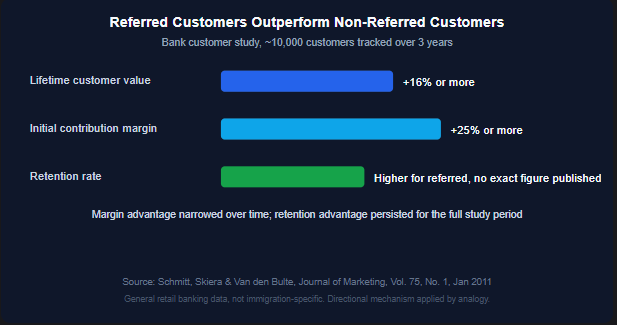
The study tracked customers who joined the bank through a referral against demographically similar customers who joined through ordinary acquisition channels during the same window. Two findings stand out. First, referred customers carried an average lifetime value at least 16% higher than comparable non-referred customers. Second, referred customers showed a meaningfully higher retention rate that persisted over the full multi-year tracking period, not just in the first few months after signup. The paper also found referred customers started out with contribution margins more than 25% higher than non-referred customers, though that particular margin gap narrowed as both groups aged.
None of that research was conducted on immigration clients, Golden Visa applicants, or professional-services referrals in general. It’s banking data. But the underlying mechanism the authors describe, referred customers arriving with a form of transferred trust and implicit pre-screening from the person who referred them, isn’t specific to banking. It’s a description of what a referral relationship does structurally, and that structure is identical in immigration work. A wealth manager introducing a client to a Golden Visa firm is performing the same trust-transfer and informal vetting role as the bank customer who referred a friend. Where immigration referrals differ from the bank study is stakes and duration. A Golden Visa case runs for months, sometimes over a year, and the amounts involved often exceed $500,000 in combined investment and legal costs. If pre-qualification and trust matter for a retail banking product, they should matter more, not less, in a decision this size and this slow.

Why Would a Referral Convert Better Than an Ad-Driven Lead in the First Place?
Three mechanisms explain the gap, and none of them require immigration-specific data to hold up. They follow directly from how a referral actually happens.
Pre-qualification. The referring party has usually already assessed whether the client’s investment budget, timeline, and family situation fit a realistic Golden Visa or immigration path. A tax advisor who understands roughly what a fund-based Golden Visa route requires won’t refer a client who can’t meet the minimum investment. A cold lead from a search ad has done none of that filtering. The firm has to do it from scratch, and some fraction of those leads wash out during that process.
Transferred trust. A referred client extends some of their existing trust in the referring advisor to the firm being recommended. That’s a head start no advertisement can replicate. It shortens the distance between first contact and a client feeling comfortable enough to sign an engagement letter, hand over sensitive financial documents, and commit to a process that can take a year or longer.
Reduced education burden. Referred clients typically arrive with at least a rough understanding of what they’re being pointed toward and why. Cold leads often need the entire category explained before the firm can even determine fit. That education time isn’t wasted exactly, but it’s time spent with no guarantee of a signed case at the end, and it delays the moment a genuinely qualified lead can move forward.
Firms managing referral pipelines through MezAgent consistently describe a shorter runway between first contact and signed engagement for their referred caseload, even accounting for how long Golden Visa cases already run compared with marketing-sourced clients. That’s not a controlled study, but it lines up with exactly what the pre-qualification and trust-transfer mechanisms would predict.
How Big Is the Gap, Specifically, for Immigration and Golden Visa Cases?
Here’s where honesty matters more than a tidy number. There is no peer-reviewed study measuring a specific conversion-rate percentage for referred versus cold-sourced immigration or Golden Visa clients. Any specific percentage you see attached to “immigration referral conversion rate” online should be treated with real skepticism, since it’s very likely to trace back to a referral software vendor’s blog post rather than independent research.
What can be said honestly: the Schmitt, Skiera, and Van den Bulte findings on general referred-customer value and retention describe a mechanism, transferred trust plus pre-qualification, that applies with at least equal force to immigration work. Golden Visa cases are higher-stakes, slower-moving, and more document-intensive than a retail banking product. If pre-qualification measurably improved retention and value for people opening a bank account, there’s no reason to expect it matters less for someone committing six figures and a year of their life to a residency application. The direction of the effect is well established. The exact magnitude, for this specific vertical, isn’t something anyone can currently cite honestly as a hard percentage.
Does the Trust Gap Matter More for Golden Visa Cases Than Ordinary Visas?
Trust matters in every immigration case, but Golden Visa work raises the stakes in ways that make a warm introduction unusually valuable. The investment amounts are large, commonly upward of $500,000 once fund minimums, government fees, and legal costs are combined. The timeline from introduction to a final decision often stretches past a year. A client committing that much money and time wants real confidence in who they’re working with before they’ll sign anything.
A cold lead evaluating an unfamiliar firm for a decision of this size has to do all of that confidence-building through the firm’s own marketing, reviews, and first few calls. A referred client has already outsourced part of that confidence-building to someone they trust. That’s precisely the transferred-trust mechanism the banking study describes, just operating on a decision with much higher stakes than opening a checking account. How Immigration Firms Track Which Agent Referred Which Client covers how firms keep that trust chain traceable once the case is underway.
For example: a relocation consultant in Singapore refers a client to a Lisbon-based Golden Visa firm after confirming the client’s investment budget and residency timeline match a fund-based route. The client’s first call with the firm skips the “can I even qualify” conversation entirely. It starts instead with fund selection and documentation, the actual substantive work. That’s a meaningfully different starting point than a cold inquiry that begins with basic eligibility questions.
What Should a Firm Actually Do With This Gap?
Firms that understand why referred clients close more often tend to treat referral relationships as worth actively cultivating, not just passively accepting when they show up. That means being responsive to referring partners, giving them honest feedback on the leads they send, and making the pipeline easy to track so nobody’s introduction gets lost in an inbox. 5 Ways Immigration Firms Vet Agents Referring Cross-Border Clients goes through how firms build that kind of referral network deliberately rather than by accident.
The practical implication for a referring partner is similar. The value you add isn’t just making an introduction. It’s the pre-qualification and trust transfer that introduction carries. Referring partners who do that screening carefully, and who understand enough about the relevant visa or Golden Visa category to make an accurate match, are the ones firms keep prioritizing.
Frequently Asked Questions
Do referred immigration clients really convert at higher rates than cold leads?
The direction of the effect is well supported by peer-reviewed research on referred customers generally, including a 2011 Journal of Marketing study showing referred bank customers carried at least 16% higher lifetime value and a meaningfully higher retention rate than non-referred customers. There is no immigration-specific peer-reviewed study with a precise conversion percentage, but the underlying mechanism, pre-qualification plus transferred trust, applies directly to referred immigration and Golden Visa clients.
What’s the source for the 16% higher value statistic?
It comes from Schmitt, Skiera, and Van den Bulte, “Referral Programs and Customer Value,” published in the Journal of Marketing, Vol. 75, No. 1, in January 2011. The study tracked close to 10,000 customers of a German retail bank over nearly three years, comparing referred customers to demographically similar non-referred customers. It is not an immigration-specific study.
Why do referred clients need less education before signing an engagement?
A referring party, such as a wealth manager or tax advisor, has usually already assessed the client’s budget, timeline, and rough eligibility before making the introduction. That pre-qualification means the immigration firm doesn’t have to build that understanding from scratch, unlike with a cold lead who may not yet know whether they qualify for any program at all.
Is the conversion advantage the same for every referral source?
No. The Journal of Marketing study specifically found the value differential varied across customer segments, and recommended a selective approach rather than assuming every referral behaves identically. The same logic likely applies in immigration work: a referral from an advisor who deeply understands a client’s finances is not equivalent to a casual acquaintance introduction with no real screening behind it.
The Bottom Line
Referred immigration clients close more often than cold leads for reasons that are well-documented in peer-reviewed research on referred customers generally, even though no study has isolated the exact percentage for this specific vertical. Pre-qualification and transferred trust are the mechanism, and both matter more, not less, in a slow-moving, high-stakes decision like a Golden Visa application. Firms that treat referral relationships as a serious channel, not an afterthought, are acting on evidence that holds up.
Sources
- Philipp Schmitt, Bernd Skiera, and Christophe Van den Bulte, “Referral Programs and Customer Value,” Journal of Marketing, Vol. 75, No. 1, January 2011, retrieved 2026-07-08. https://journals.sagepub.com/doi/10.1509/jm.75.1.46
This article is for general informational purposes only and is not legal, immigration, or financial advice. Conversion outcomes vary by firm, market, and case type, and no single study can predict results for a specific referral relationship. Consult a licensed immigration attorney or qualified advisor before making decisions based on the general research described here.