Insights7 min read
Are Referral Fees Tax Deductible for the Business Paying Them?
Referral fees can usually be deducted as a business expense if they are genuinely for the business, properly documented and lawful. What to keep on file.

Published 22 November 2026
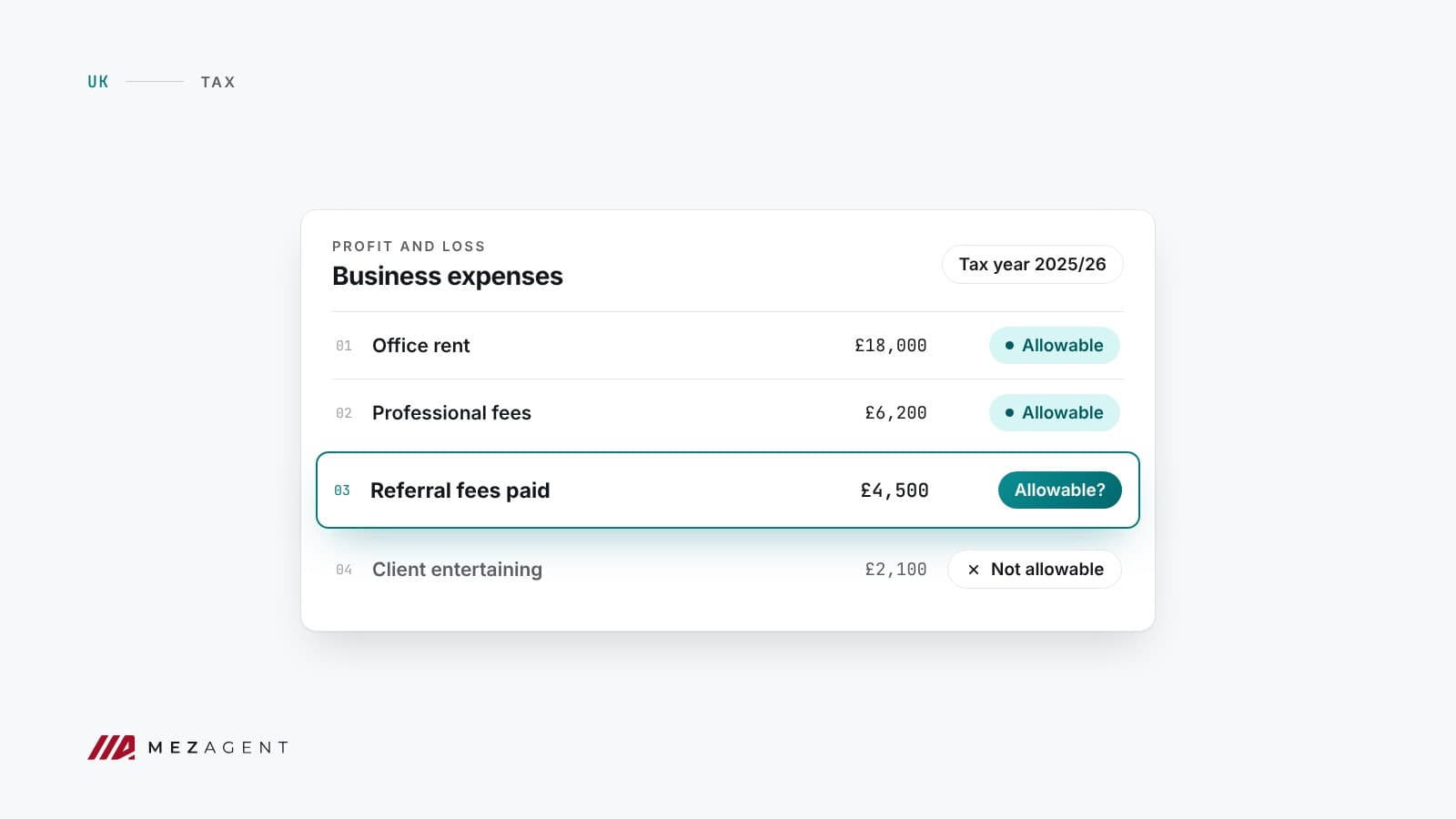
In many countries, a referral fee paid to win business can be treated as a business expense, as long as it is genuinely for the business, properly documented and lawful. In the UK, the general test is whether the cost is incurred wholly and exclusively for the purposes of the trade. Rules differ by country, so confirm the treatment with your accountant.
Referral fees are one of the more straightforward costs of winning clients. You pay only when an introduction turns into business, and the payment has an obvious commercial purpose. Even so, how it is treated for tax depends on how the fee is set up, how it is paid and what records you keep.
This guide looks at the general position for businesses paying referral fees and commissions, with a focus on the UK and short notes on other markets where MezAgent members operate. It covers the payer's side. If you receive referral fees, read our guide to whether you owe taxes on referral commission income.
Key Takeaways
- In the UK, the test is whether the cost is incurred wholly and exclusively for the purposes of the trade and is not capital in nature.
- A referral fee paid to win a client usually has a clear business purpose, but it fails the test if it is really a personal payment, undocumented or unlawful.
- Each payment needs a paper trail: the referral agreement, the introducer's invoice, proof of payment, evidence the deal criteria were met and a client file reference.
- Cross-border payments add withholding, reporting and currency questions, so check with an adviser before paying, not after.
What Counts as a Referral Fee for Tax Purposes?
A referral fee is a payment to someone who introduced a client to your business. It may be a fixed amount or a percentage of the deal, in which case it is often called a commission. For tax purposes, the label matters less than the substance: what the payment was for, who received it and whether it was connected to your trade. Our guide to referral fee vs commission explains the terms.
Is a Referral Fee a Business Expense in the UK?
For UK businesses, the starting point is the wholly and exclusively rule. A cost is generally deductible when calculating trading profits if it is incurred wholly and exclusively for the purposes of the trade, and is not capital in nature. HMRC explains the test in its Business Income Manual.
A referral fee paid to win a client usually has a clear business purpose. Problems tend to arise in a few situations:
the fee is really a personal payment or a favour to a friend or family member
the introducer did nothing that can be shown, and there is no agreement
the fee is linked to a capital transaction rather than ordinary trading
the payment itself is unlawful
Whether a particular fee passes the test depends on the facts. Your accountant can tell you how it applies to your business.
What Records Should a Business Keep?
Good records are what turn a reasonable expense into one you can defend if it is ever questioned. Keep these for every referral fee you pay:
| Record | What it shows |
|---|---|
| Written or digital referral agreement | What the fee was for, and the agreed terms |
| Invoice from the introducer | The amount, date and who is being paid |
| Proof of payment | That the money went to the right person or company |
| Evidence the deal criteria were met | Why the fee became due |
| Client file reference | Which client and deal the fee relates to |
Can I Deduct a Fee Paid to an Overseas Introducer?
A digital referral agreement helps here. On MezAgent, the fee type, amount and trigger are agreed before the client is introduced, and the deal is tracked to the point where the fee becomes due. That gives you a clear record linking each payment to a specific introduction.
Fees paid to introducers in other countries can often be deductible on the same basis as fees paid locally, provided the wholly and exclusively test is met and the payment is properly documented. Cross-border payments do raise a few extra questions:
Paperwork in another language or format. Keep an English summary or translation where needed.
Currency. Record the amount in your own currency at the rate used on the payment date.
Withholding or reporting rules. Some countries require tax to be withheld on certain payments abroad, or ask for the payment to be reported. Check with your adviser before you pay.
Who the introducer is. Payments to individuals or companies in some low-tax jurisdictions can face extra checks in certain countries.
Checking who you are paying also matters outside tax. Our guide to introducer due diligence covers identity, licensing and payment checks.
When Might a Referral Fee Not Be Deductible?
A referral fee is unlikely to be deductible, and could create much bigger problems, if the payment is unlawful. In the UK, HMRC guidance explains that expenditure involving crime, including bribes, is not allowed as a deduction (BIM43100).
Some referral fees are also prohibited by sector rules. For example, solicitors in England and Wales cannot pay referral fees in personal injury cases. A fee that breaks those rules raises regulatory questions long before tax is considered. See our guide on whether law firms can pay referral fees to non-lawyers.
How Do Other Markets Treat Referral Fees?
Each country has its own rules, but the broad principle is similar in many places: the expense must be connected to the business and properly evidenced. Some quick, general notes:
| Market | General position | Where to check |
|---|---|---|
| Greece | Business expenses generally need to be linked to the business and supported by proper tax documents. Larger payments are expected to go through a bank. | AADE, Independent Authority for Public Revenue |
| Cyprus | Expenses are generally deductible when incurred wholly and exclusively in producing taxable income. | Cyprus Tax Department |
| UAE | Corporate tax applies to many businesses, and expenses are generally deductible when incurred wholly and exclusively for the business. | UAE Federal Tax Authority |
| Portugal | Costs generally need to be documented and connected to the business, with extra scrutiny for some payments abroad. | Portal das Financas |
How Does a Digital Referral Agreement Help at Tax Time?
These notes are a starting point only. Check current rules with a local accountant before you rely on them.
Most problems with referral fees come from missing evidence, not from the fee itself. A handshake deal, a WhatsApp message and a bank transfer with no reference make it hard to show what you paid for.
On MezAgent, each introduction comes with a digital referral agreement that records the fee, the trigger and the payment period. The deal is tracked by both sides, so you can show when and why the fee became due. MezAgent takes 0% platform commission, so the full fee goes to the introducer and is easy to match to their invoice.
You can see how this works for firms on our page for businesses, and the agreement itself on our fee agreement page.
Frequently Asked Questions
Is a referral fee a business expense?
Often, yes. In many countries, including the UK, a referral fee paid to win business can be deducted if it is incurred wholly and exclusively for the business, properly documented and lawful. Your accountant can confirm how this applies to you.
What paperwork do I need?
Keep the referral agreement, the introducer's invoice, proof of payment, evidence that the deal criteria were met and a reference to the client file. Together these show what the fee was for and why it became due.
Can I deduct a fee paid to an overseas introducer?
Often you can, on the same basis as a local fee, if it meets the business purpose test and is properly documented. Cross-border payments may raise withholding, reporting or currency questions, so check with your adviser before paying.
The Bottom Line
A referral fee is usually deductible for the business paying it when it is a genuine trading cost, properly evidenced and lawful. The fee itself is rarely the problem. The problem is a payment nobody can reconstruct six months later.
Keep the agreement, the invoice, proof of payment, evidence that the deal criteria were met and a client file reference. That package is what turns a reasonable expense into one you can defend.
Sources
This article is for general informational purposes only and is not legal, tax, or immigration advice. Rules vary by jurisdiction and change frequently. Consult a licensed professional before making decisions based on this content.
Free forever for professionals. No card required.
Sign up