Maria has sixteen years in residential real estate and a closing date for her own career: six months out. She still has an active buyer, a couple she’s worked with for four months who are close to an offer. Keeping the deal means one more commission check. Referring it means a smaller payout now, and no more calls after that.
This is the exact decision more agents are facing. The median age of a Realtor is now 57, and 44% of Realtors are over age 60, according to NAR’s 2025 Member Profile data (National Association of Realtors, 2025). A large slice of the industry is closer to an exit than a start. Most of them will hit Maria’s exact fork: refer the client and step away cleanly, or hold the deal and delay the exit.
This case study walks through how that decision actually gets made, using a realistic illustrative scenario built from common patterns agents describe. Maria isn’t a real person. Her numbers are typical of what agents report, not a single verified transaction.
Key Takeaways
- Retiring agents commonly ask for 30% or more in referral fees, above the roughly 25% standard benchmark, because they’re giving up a long-term relationship rather than making a one-time introduction.
- No government body or peer-reviewed study tracks a precise “30% retiring agent” figure. It shows up consistently in real estate trade coverage and brokerage succession guidance, not in regulatory data, so treat it as an industry norm rather than a hard rule.
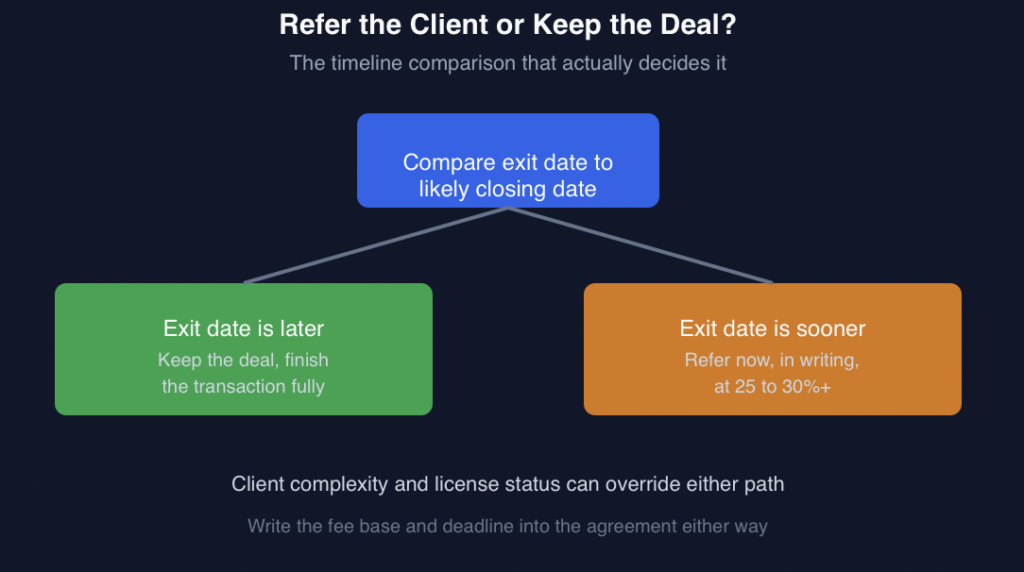
- Referring makes sense when the agent’s exit timeline is shorter than the deal’s likely closing timeline. Keeping the deal makes sense when closing is near and the agent can still deliver full service.
- A written referral agreement, signed before the introduction, is what actually protects the fee. A verbal understanding between two agents who’ve known each other for years is not a substitute.
Why This Decision Is Different From a Normal Referral
A normal referral happens because an agent can’t serve a client well, usually due to geography or specialty mismatch. A retirement referral is different because the agent could serve the client. They’re simply not going to be in the business much longer. That changes the calculus on both sides of the deal.
The referring agent isn’t protecting a reputation for future referrals the way a still-active agent would. There’s no ongoing relationship with the receiving agent to maintain past this one handoff, unless the two of them build a broader succession arrangement. The retiring agent is, in effect, cashing out a relationship rather than making an introduction. Real Estate Referral Commissions: How Agents Get Paid for Property Introductions.

The Case: Maria’s Active Buyer and a Six-Month Exit
Maria plans to close her brokerage relationship in six months. She has one active buyer client, a couple mid-search for a $650,000 single-family home, likely to make an offer within six to eight weeks. The listing side commission on a deal that size runs about 2.5%, or roughly $16,250 in gross commission if the deal closes at asking price.
Two paths sit in front of her. She can keep working the deal herself through closing, which probably happens before her retirement date if the timeline holds. Or she can refer the couple now to a colleague at her brokerage who plans to stay active for years, and step back from any remaining work on the file.
For example: if Maria refers now, she and the receiving agent agree to a 30% fee on the eventual gross commission. That’s roughly $4,875 to Maria if the deal closes at the estimated price, paid once the receiving agent closes it. Keep the deal instead, and Maria stands to earn the full $16,250, assuming she has the bandwidth left to finish the job well over the next two months.
What Actually Determines the Right Call?
The right call depends mostly on whether the agent’s remaining timeline covers the deal’s likely closing timeline, not on which number looks bigger on paper. An agent with eight weeks left and a buyer six weeks from an offer can probably finish the job. An agent with three weeks left and a buyer who just started touring homes almost certainly cannot.
Four factors decide it in practice. Timeline fit is the first and biggest: does the agent’s remaining availability actually cover the deal to closing, including a slow financing or inspection stretch. Client complexity is the second. A first-time buyer needing hand-holding through every step is a worse candidate for a rushed final sprint than an experienced repeat buyer who mostly needs paperwork managed. Relationship depth is the third factor. A four-month working relationship, like Maria’s, transfers more smoothly than a client the agent has known for years and expects continuity from. License and brokerage status is the fourth. Some states and brokerages restrict what a agent can still legally do once they’ve deactivated a license, which can force the referral decision regardless of preference.
The instinct is to run the math on the fee percentage. In practice, the bigger risk sits somewhere else: an agent who keeps a deal past their real capacity to finish it well, then rushes the last month, tends to produce a worse outcome for the client than a clean handoff would have. The fee difference rarely offsets that risk once it shows up.
Why Do Retiring Agents Ask for 30% or More?
Retiring agents commonly request referral fees of 30% or higher, above the roughly 25% figure that functions as the standard baseline for a one-time referral. The reasoning is straightforward: they’re not making an introduction they’ll benefit from again. They’re giving up years of trust-building with a client they built the relationship with, often over multiple past transactions.
It’s worth being precise about where that 30% figure actually comes from, because the sourcing here is weaker than it looks on the surface. Real estate trade publications and brokerage succession-planning guides report the pattern consistently. HousingWire’s 2026 referral fee guide notes that retiring agents “often request 30% or more in exchange for handing over a long-term client relationship” (HousingWire, 2026). Brokerage succession programs describe similar terms when an agent formally transitions their book. But no government agency, state real estate commission, or peer-reviewed study tracks or publishes a verified average for this specific figure. It’s an industry-reported norm, repeated widely, not a regulated or independently audited statistic. Treat 30% as a common starting point for negotiation, not as evidence of a fixed market rate.
Agents building out referral relationships on MezAgent ahead of a retirement describe the same pattern from the other side. The receiving agent rarely pushes back hard on 30% for a single active deal. Where the negotiation gets real is on a full book handoff spanning dozens of past clients over one or two years, where the percentage and the duration both need to be nailed down in writing.
The Real Referral Fee Percentage in Real Estate for 2026.
What Should a Retirement Referral Agreement Actually Say?
A retirement referral agreement needs to specify more than a percentage. It needs the fee base, the deal or deals it covers, and how long the arrangement runs, since retirement handoffs sometimes cover more than one transaction. Skipping any of these three is where later disputes usually start.
The fee base matters as much here as in any other referral: 30% of gross commission before brokerage splits produces a very different dollar figure than 30% of net commission after the receiving agent’s broker takes a cut. The agreement should also name the specific client or clients covered, since a retiring agent handing off an entire pipeline needs each relationship listed, not a vague reference to “my remaining clients.” Duration matters too. A single-deal referral needs a closing deadline, typically 12 to 24 months. A full book handoff might run one to two years and needs its own end date specified in writing, not left open-ended.
How the 2024 NAR Settlement Changed Real Estate Referral Agreements.
How Did Maria’s Case Actually Play Out?
In this scenario, Maria referred the buyers to a colleague four weeks before her original retirement date, once it became clear the couple was still two months from making an offer. She and the receiving agent signed a referral agreement specifying 30% of gross commission, a fee base defined as pre-brokerage-split, and a 18-month closing deadline covering this one transaction.
The deal closed five months later at $637,000, slightly under the original estimate. Gross commission on the listing side came to $15,925. Maria’s 30% share was $4,777.50, paid through her former brokerage once the receiving agent’s side confirmed the closing. She never handled another showing for that couple after the referral date.
The alternative path she didn’t take: pushing her retirement date back two months to close the deal herself. That would have meant delaying the transition she’d already told her brokerage and family she was making, for a difference of roughly $11,000 before broker splits. She decided the timeline risk and the delay weren’t worth it. That’s a judgment call, not a formula, and a different agent in the same position might reasonably choose the other path.
What Cross-Border and Multi-Deal Retirements Look Like
Some retiring agents aren’t handing off one active deal. They’re handing off an entire remaining client pipeline, sometimes including relationships that stretch across borders if the agent worked with relocating or international clients during their career. That version of the decision needs a more structured agreement than a single-transaction referral does.
A full book handoff typically names every client in the pipeline, sets a uniform fee percentage across all of them, and runs for a defined window, often one to two years, rather than the 12 to 24 month deadline that fits a single deal. If any of those clients are relocating internationally, the same cross-border tax withholding rules that apply to any referral fee apply here too, referral fee percentage aside.
Frequently Asked Questions
Should I refer a client if I’m retiring from real estate in a few months?
It depends on whether your remaining timeline covers the deal’s likely path to closing. If your exit date comes before the deal would reasonably close, referring protects the client from an unfinished handoff and still pays you a fee. If you have real runway left and the client isn’t complex, finishing the deal yourself usually pays more.
What referral fee percentage do retiring agents typically get?
Retiring agents commonly negotiate 30% or higher, above the roughly 25% standard for a one-time referral. That figure comes from real estate trade coverage and brokerage succession guidance, not from a government or peer-reviewed source, so treat it as a common industry starting point rather than a fixed benchmark.
How do you hand off an entire client book when retiring, not just one deal?
A full book handoff should name every client covered, set one fee percentage across the pipeline, and specify a defined time window, often one to two years, during which the arrangement applies. Put it in writing and have both brokerages sign it before any client introductions happen.
Can a retiring agent keep earning referral fees indefinitely?
Generally no. Most referral agreements specify a fixed window, commonly 12 to 24 months for a single deal or up to a couple of years for a full book handoff. Once that window closes, any later deal with that client typically doesn’t carry a referral fee unless a new agreement is signed.
What happens if the retiring agent’s license lapses before the deal closes?
Referral fees must route through a licensed brokerage relationship. If an agent’s license lapses or deactivates before the deal closes, check state rules and brokerage policy on whether the referral fee can still be paid and how. This varies by state, so confirm it with a broker or attorney before the license status changes.
The Bottom Line
Maria’s fork is common and getting more common as the industry’s median age climbs. The decision comes down to a timeline comparison more than a fee comparison: can the agent’s remaining availability actually cover the deal through closing, or does the exit date arrive first. Retiring agents commonly negotiate 30% or more for a referral, a figure that shows up consistently in trade coverage rather than regulatory data, so it’s worth treating as a norm to negotiate around, not a rule to assume.
Whichever path fits, the paperwork does the same job either way. A written agreement, a specified fee base, and a real deadline are what actually protect the retiring agent’s payout, not the relationship history behind the handoff.
Sources
- National Association of Realtors, “Income Steady, Even as Market Slows: 2025 Member Trends,” 2025, retrieved 2026-07-07. https://www.nar.realtor/magazine/real-estate-news/sales-marketing/income-steady-even-as-market-slows-2025-member-trends
- HousingWire, “Real Estate Referral Fees: The Ultimate Guide for 2026,” 2026, retrieved 2026-07-07. https://www.housingwire.com/articles/real-estate-referral-fees/
This article is for general informational purposes only and is not legal, tax, or real estate advice. Referral fee arrangements, licensing rules, and brokerage requirements around agent retirement vary by state and brokerage and change over time. Consult a licensed real estate attorney or broker before entering into or relying on any referral agreement described here. The case study in this article, including “Maria,” is an illustrative scenario built from common industry patterns, not a real person or transaction.