A buyer in Singapore signs with a Miami agent she’s never met, on the strength of a two-line email from a broker she trusts back home. That’s the entire due diligence process most cross-border buyers get to run. They aren’t choosing an agent. They’re accepting whoever their referring contact hands them off to, sight unseen, often before they’ve even booked a flight.
That arrangement puts a strange amount of weight on the referring agent’s judgment, and most referring agents treat it too casually. They think the job ends at finding someone licensed in the right city. It doesn’t. International buyers purchased $56 billion worth of US existing homes between April 2024 and March 2025, a 33.2% jump over the prior year (National Association of Realtors, 2025). Every one of those transactions started with somebody’s introduction, and the buyer had no way to vet the receiving agent beyond trusting the person who sent them.
Key Takeaways
- Cross-border buyers can’t independently vet a receiving agent, so they judge the referring agent’s credibility as a proxy for the whole transaction.
- Nearly half of international buyers, 47%, pay in cash, according to NAR’s 2025 research, which changes what a receiving agent needs to know compared to a typical financed US buyer.
- Foreign buyers who live abroad account for 44% of international purchases, which means language, time zone, and remote-closing capability are recurring, not occasional, requirements.
- License in the destination market is table stakes. Buyers actually judge a referral against destination-specific tax, financing, and disclosure fluency.
- Cross-border introductions with a documented handoff brief tend to move faster and draw fewer buyer complaints than informal, verbal handoffs, based on patterns observed across referral relationships tracked through MezAgent, not a controlled study.
A Cross-Border Referral Strips Away the Usual Trust Signals
A cross-border referral removes every normal trust signal a buyer would otherwise rely on. There’s no local reputation to check, no mutual friend who used the agent before, and often no shared first language to fall back on. The buyer is trusting a stranger’s judgment about another stranger, twice removed from anything they can verify themselves.
Domestic referrals get some of that trust for free. A buyer moving across state lines can still Google the receiving agent and ask mutual contacts. A buyer moving from Dubai to London or Singapore to Miami usually can’t do that reliably. Foreign buyers who resided outside the US accounted for 44% of international purchases in NAR’s most recent data, meaning a large share decide entirely from abroad, sight unseen, before setting foot in the destination market (National Association of Realtors, 2025).
That’s why the referring agent’s credibility becomes the whole trust chain. Buyers aren’t evaluating the receiving agent on independent merit. They’re extending trust they already placed in the referring agent and expecting it to transfer cleanly.

Destination-Market Fluency Is the Real Standard, Not a License
Cross-border buyers judge a referral against destination-market fluency, not just a license number. Holding a real estate license in Miami or London is a baseline requirement, not a differentiator. What separates a strong referral from a weak one is whether the receiving agent can speak knowledgeably about the rules that apply to a foreign buyer in that market, on the first call.
Most referring agents assume “licensed and available” is enough. It isn’t, and buyers notice the gap fast. A receiving agent who can’t answer a foreign-buyer tax question in the first conversation loses credibility immediately, and that reflects back on whoever made the introduction.
Three things come up constantly in what buyers expect a receiving agent to already know:
- Foreign-buyer disclosure and reporting requirements. A Singapore-to-Miami buyer needs an agent who understands FIRPTA withholding on the eventual resale, not just standard closing disclosures.
- Financing paths available to non-residents. Many foreign buyers can’t get a conventional mortgage on the terms a domestic buyer expects, and a receiving agent unfamiliar with foreign national loan programs sends the buyer down a dead end.
- Local property tax and transfer cost differences. A Dubai buyer moving to London needs someone conversant in the UK’s stamp duty surcharge for non-resident purchasers, not a generalist who has to look it up mid-negotiation.
For example: a buyer relocating from Dubai to London needs an agent who already knows the stamp duty surcharge structure for non-resident buyers before the first property tour happens. A generalist agent willing to take the referral isn’t the bar. Matching that specific expertise is the referring agent’s actual job, and it’s a different job than simply finding someone licensed in the right postcode.
Cash Purchases Change What a Receiving Agent Needs to Know
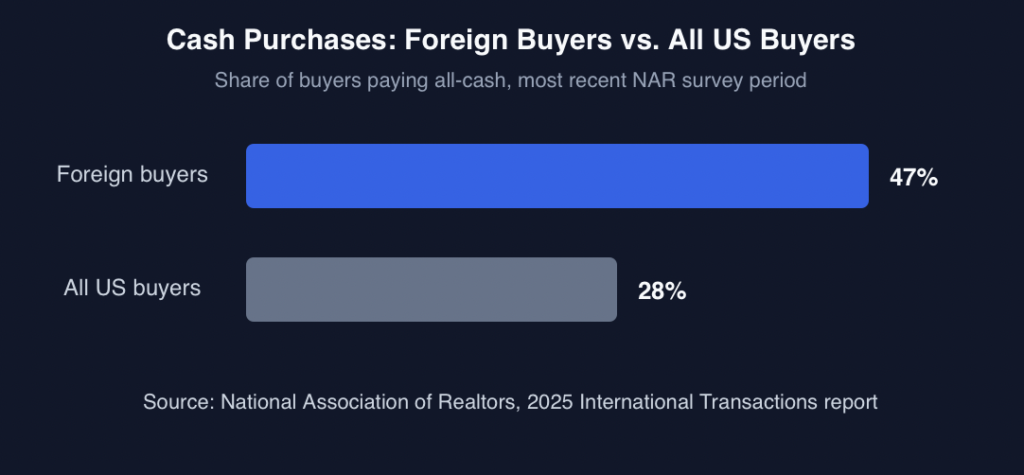
Cash purchases are far more common among international buyers than domestic ones, and that changes what a receiving agent needs to be ready for. Forty-seven percent of foreign buyers paid all-cash in NAR’s most recent survey period, compared with 28% of all US existing-home buyers (National Association of Realtors, 2025). That’s a meaningfully different transaction profile.
An agent used to walking domestic buyers through mortgage pre-approval is solving the wrong problem for nearly half this buyer pool. Cash buyers care more about proof-of-funds documentation that satisfies anti-money-laundering requirements, wire transfer logistics across currencies, and closing timelines that aren’t gated by underwriting. A receiving agent who defaults to a financing-first playbook signals, in the first conversation, that they haven’t handled this buyer profile before.
Referral relationships tracked through MezAgent show a pattern we’ve noticed, not a controlled study: cross-border introductions with the strongest outcomes almost always included a short handoff brief covering payment method, currency, and timeline before the receiving agent’s first call. The ones that stumbled were the ones where the receiving agent learned the buyer was paying cash from abroad only after the initial conversation had already gone sideways.
Language and Time Zone Fit Is a Requirement, Not a Nice-to-Have
Language and time zone alignment function as a real requirement in cross-border referrals, not a soft preference. A buyer negotiating a purchase from another continent can’t drop by an office or join a same-day showing. Every interaction has to work around a time difference that can run eight, ten, or twelve hours, plus a communication gap a shared first language would otherwise smooth over.
Domestic buyers tolerate a slow email reply because they can call, text, or show up. Cross-border buyers don’t have that flexibility, so a receiving agent’s response time carries more weight than in a local transaction. A referring agent who matches a buyer to a receiving agent purely on license and availability sets up friction the buyer feels from the first exchange. Real Estate Referral Commissions: How Agents Get Paid for Property Introductions.
A Sloppy Handoff Undermines Even a Qualified Receiving Agent
A sloppy handoff undermines even a technically qualified receiving agent, because the buyer experiences the referral as one continuous relationship, not two separate ones. If the introduction arrives as a vague forwarded email with no context, the buyer notices the gap immediately, even if the receiving agent turns out to be excellent once engaged.
The failure pattern is predictable. A referring agent sends a one-line email: “Meet Jane, she’s looking in Lisbon, can you help?” The receiving agent has no idea what the buyer’s budget is, whether financing is secured, or what timeline they’re working against. The buyer has to re-explain their situation from scratch, which reads as a lack of coordination on both sides, not just one.
Introductions logged through MezAgent with a structured handoff, covering budget, financing status, timeline, and prior context, tended to move to a first substantive conversation faster than informal handoffs. This is a pattern we’ve noticed, not a controlled study, but buyers on the receiving end of those structured handoffs also seemed less likely to feel like they had to start over.
A referring agent who takes ten minutes to write a real handoff brief isn’t just being thorough. They’re protecting the trust the buyer placed in them by making sure it transfers to someone equipped to honor it.
What to Screen For Before Making the Introduction
A referring agent should screen a potential receiving agent on destination-specific knowledge before making the introduction, not after a buyer complains. That screening should happen once, with a trusted contact in the destination market, well before any specific buyer needs a referral. Waiting until a buyer is already in motion to figure out who’s actually qualified is how weak matches happen.
Four questions belong in that screening conversation. Has the receiving agent closed deals with foreign buyers before, and how many. Do they know the destination market’s disclosure and tax rules for non-residents. Can they realistically accommodate a buyer’s time zone for calls and virtual tours. And do they have a track record of closing, not just taking referrals and letting them go cold.
The agents who build durable cross-border referral relationships tend to maintain a short list of vetted destination contacts, built once and reused, rather than searching for someone new every time a relocating client shows up. That upfront work separates a referral that reads as considered from one that reads as a shrug.
A Cross-Border Buyer Expectation Snapshot
| What buyers expect | Why it matters | What it looks like in practice |
|---|---|---|
| Destination-specific tax and disclosure fluency | License alone doesn’t cover foreign-buyer rules | Agent can explain FIRPTA, stamp duty surcharges, or local equivalents unprompted |
| Comfort with cash and cross-currency transactions | 47% of foreign buyers pay all-cash | Agent has a proof-of-funds and wire process ready, not a mortgage-first script |
| Time zone and language accommodation | 44% of foreign buyers purchase from abroad | Calls scheduled around the buyer’s hours, not the agent’s |
| A real handoff brief, not a one-line intro | Buyers experience the referral as one relationship | Budget, financing status, and timeline shared before first contact |
| Evidence of prior foreign-buyer closings | Track record signals lower transaction risk | Agent can point to specific past cross-border deals |
Frequently Asked Questions
What do international property buyers expect from a referring agent?
International buyers expect the referring agent to match them with someone who understands the destination market’s foreign-buyer rules, not just someone holding a local license. That includes tax and disclosure requirements, financing options for non-residents, and enough time zone flexibility to communicate without the buyer needing to be physically present.
Why do cross-border buyers trust the referring agent more than the receiving agent at first?
Cross-border buyers usually can’t independently verify a receiving agent in an unfamiliar country, so they extend the trust they already placed in the referring agent instead. That makes the referring agent’s judgment the effective trust signal for the whole transaction, at least until the receiving agent proves themselves directly.
Do cross-border buyers pay for property in cash more often than domestic buyers?
Yes. Forty-seven percent of foreign buyers paid all-cash in NAR’s most recent international transactions survey, compared with 28% of all US existing-home buyers. That means receiving agents need to be ready for proof-of-funds documentation and wire transfer logistics, not just mortgage pre-approval conversations.
What should a referring agent include in a cross-border handoff?
A useful handoff includes the buyer’s budget, financing status, property must-haves, timeline, and any context from prior conversations. Sending a one-line introduction without that context forces the buyer to re-explain their situation from scratch, which reads as a lack of coordination.
Does a real estate license in the destination country guarantee a good referral match?
No. A license is a legal requirement, not a quality signal for a cross-border referral. Buyers judge the match against whether the receiving agent already understands foreign-buyer tax rules, financing paths, and disclosure requirements specific to that market, which a license alone doesn’t confirm.
The Bottom Line
Cross-border buyers don’t get to shop around the way domestic buyers do. They’re trusting a referring agent’s judgment about a stranger in another country, often before they’ve seen the destination city in person. That’s a heavier obligation than most referring agents treat it as. Matching on license and availability alone routinely produces referrals that technically work and still leave the buyer feeling like an afterthought.
The agents who get this right screen destination contacts before a buyer ever needs one, write a real handoff brief instead of a one-line email, and match buyers to receiving agents who already speak the specific language of that market’s foreign-buyer rules. That’s the actual job. Finding someone licensed in the right city is just the floor. Real Estate Referral Commissions: How Agents Get Paid for Property Introductions.
Sources
- National Association of Realtors, “International Buyers Purchased $56 Billion Worth of U.S. Homes from April ’24 to March ’25,” July 2025, retrieved 2026-07-08. https://www.nar.realtor/newsroom/international-buyers-purchased-56-billion-worth-of-u-s-homes-from-april-24-to-march-25
- National Association of Realtors, “International Transactions in U.S. Residential Real Estate,” 2025 Profile, retrieved 2026-07-08. https://www.nar.realtor/research-and-statistics/research-reports/international-transactions-in-u-s-residential-real-estate
This article is for general informational purposes only and is not legal, tax, or real estate advice. Referral practices, licensing requirements, and cross-border transaction rules vary by jurisdiction and change frequently. Consult a licensed real estate attorney, broker, or tax professional before entering into or relying on any referral arrangement described here.